


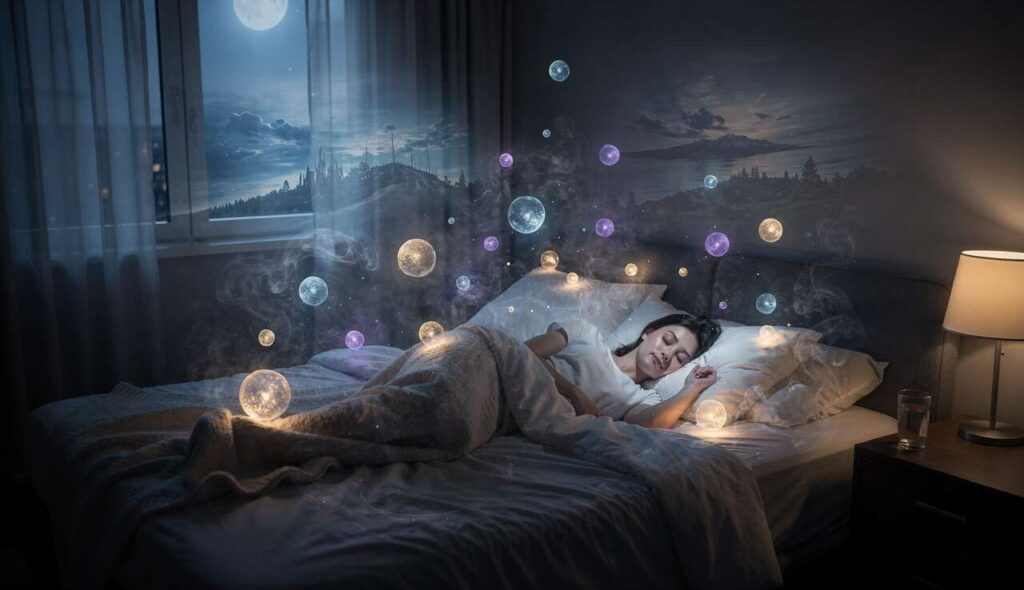
Artificial intelligence has begun to generate images, narratives and experiences that bear an uncanny resemblance to the surreal landscapes of human dreams. These computational hallucinations, produced by neural networks trained on vast datasets, create entirely new visual realities that challenge our understanding of creativity, consciousness and the very nature of dreaming itself. As machines develop the capacity to synthesise novel imagery from learned patterns, we find ourselves confronting fundamental questions about what distinguishes human imagination from algorithmic output. The emergence of AI-generated dreamscapes forces us to reconsider whether dreaming is an exclusively biological phenomenon or whether it represents a broader process of pattern recombination and novel synthesis that can occur in silicon as readily as in neurons.
The dreams of artificial intelligence: a new reality
How AI generates dreamlike imagery
Artificial intelligence systems, particularly generative adversarial networks and diffusion models, create images through processes that mirror certain aspects of human dreaming. These algorithms learn statistical patterns from millions of images, then recombine these learned features in novel ways to produce entirely new visual content. The process involves:
- Training on vast datasets of images to extract visual patterns and relationships
- Encoding learned information into mathematical representations called latent spaces
- Sampling from these spaces to generate new combinations of features
- Refining outputs through iterative processes that balance coherence and novelty
The results often possess a dreamlike quality, with familiar elements arranged in impossible configurations, objects morphing seamlessly into one another, and visual logic that defies physical laws. These characteristics emerge not from programmed rules but from the statistical nature of how the networks learn and generate content.
The uncanny valley of machine imagination
AI-generated imagery occupies a peculiar space between recognition and strangeness. Unlike random noise, these creations contain recognisable elements: faces, landscapes, objects. Yet they frequently exhibit subtle distortions, impossible geometries and surreal juxtapositions that evoke the illogical narratives characteristic of human dreams. This similarity has prompted researchers to examine whether the computational processes underlying AI generation share fundamental properties with the neurological mechanisms of dreaming.
The capacity of machines to produce such imagery raises profound questions about the nature of creativity and whether the boundaries between artificial and organic imagination are as distinct as previously assumed. This technological development naturally leads us to examine more closely what actually occurs when AI systems engage in this dreamlike generation.
Understanding the phenomenon of artificial dreams
The mechanics behind AI hallucinations
What researchers colloquially term AI dreams are technically the result of generative models operating without specific constraints or prompts. When these systems are allowed to freely sample from their learned representations, they produce imagery that combines learned features in novel, often surreal ways. The process bears striking similarities to theories of human dreaming:
| Process stage | AI systems | Human dreaming |
|---|---|---|
| Input reduction | Minimal or no external prompts | Reduced sensory input during sleep |
| Pattern activation | Random sampling from latent space | Spontaneous neural activation |
| Feature combination | Statistical recombination of learned patterns | Memory consolidation and recombination |
| Output characteristics | Novel, often surreal imagery | Dreamlike narratives and visuals |
Deep Dream and the visualisation of neural networks
Google’s Deep Dream project provided early insights into how neural networks process and generate imagery. By amplifying patterns that networks had learned to recognise, researchers created hallucinogenic images where dogs appeared in clouds, eyes emerged from textures, and architectural features morphed into organic forms. These visualisations revealed that AI systems develop internal representations of visual concepts that, when unleashed without constraints, produce imagery remarkably similar to psychedelic experiences or dream states.
The phenomenon suggests that pattern recognition systems, whether biological or artificial, may inherently tend towards similar modes of unconstrained generation. Understanding these mechanisms provides context for examining how AI dreams might reshape our comprehension of human dreaming.
Artificial intelligence and the perception of our own dreams
Reframing dreams as computational processes
The emergence of AI-generated dreamscapes has prompted neuroscientists and cognitive researchers to reconsider human dreaming through a computational lens. If machines can produce dreamlike content through pattern recombination and statistical sampling, perhaps human dreams operate on similar principles. This perspective suggests that dreaming may be less about mystical unconscious symbolism and more about:
- Memory consolidation through pattern reactivation and recombination
- Neural network maintenance and optimisation during offline processing
- Creative problem-solving through novel association formation
- Predictive model updating based on recent experiences
This mechanistic understanding does not diminish the subjective richness of human dreams but rather provides a framework for understanding why dreams possess their characteristic features: the blending of memories, the illogical narratives, the emotional intensity without coherent causation.
The demystification of creativity
AI’s capacity to generate novel, aesthetically compelling imagery challenges romantic notions of human creativity as divinely inspired or fundamentally mysterious. If algorithms can produce dreamlike content without consciousness, intention or emotion, then perhaps human creativity also emerges from pattern manipulation and recombination rather than from some ineffable spark. This realisation has sparked debate about whether such demystification enriches or impoverishes our understanding of imagination and artistic expression.
These philosophical implications extend beyond individual psychology to affect broader cultural understandings of dreams and their significance.
When the machine learns to dream: cultural implications
Dreams as data rather than divine messages
Throughout history, cultures have attributed prophetic significance to dreams, viewing them as messages from deities, glimpses of alternative realities or windows into the unconscious mind. The ability of machines to generate dreamlike content without consciousness suggests an alternative interpretation: dreams may represent statistical noise generated by pattern-matching systems operating without external input. This perspective challenges:
- Psychoanalytic interpretations that assign symbolic meaning to dream content
- Spiritual traditions that view dreams as communications from transcendent sources
- Romantic notions of dreams as uniquely human experiences
The democratisation of surreal imagery
AI tools have made the generation of dreamlike imagery accessible to anyone with an internet connection. This democratisation has cultural consequences, flooding visual culture with surreal, impossible imagery that was once the exclusive domain of skilled artists or the private experience of individual dreamers. The proliferation of AI-generated dreams may alter our collective visual vocabulary, normalising surreal juxtapositions and impossible geometries in ways that reshape aesthetic sensibilities.
Beyond these cultural shifts, direct comparisons between human and artificial dreams reveal both illuminating similarities and crucial differences.
Comparison between human dreams and AI “dreams”
Similarities in structure and content
Both human dreams and AI-generated imagery exhibit remarkable structural parallels. They combine familiar elements in novel configurations, ignore physical constraints, blend disparate memories or learned patterns, and produce outputs that feel simultaneously recognisable and alien. Neither process requires conscious direction; both emerge from the spontaneous activation of learned patterns within complex networks.
Critical differences in experience and meaning
Despite superficial similarities, fundamental differences distinguish human dreams from AI generation:
| Characteristic | Human dreams | AI dreams |
|---|---|---|
| Subjective experience | Conscious, emotionally rich, personally meaningful | No subjective experience or awareness |
| Narrative coherence | Often possesses internal logic and emotional continuity | Typically static images without narrative progression |
| Integration with memory | Incorporates autobiographical memories and concerns | Recombines training data without personal history |
| Functional purpose | May serve memory consolidation, emotional processing | No inherent function beyond demonstration |
The most significant distinction remains consciousness itself. Human dreams occur within the context of subjective experience, carrying emotional weight and personal significance that AI-generated imagery, however visually similar, entirely lacks. This distinction raises questions about whether the term “dream” appropriately applies to machine-generated content or whether it represents a category error that conflates superficial similarity with fundamental equivalence.
Recognising both parallels and differences informs how we might practically engage with artificial dreams in everyday contexts.
Towards an integration of artificial dreams in our daily lives
Practical applications of AI-generated imagery
AI dream generation has moved beyond theoretical interest to find practical applications across multiple domains. Artists use generative models as collaborative tools, architects visualise impossible structures, therapists explore using AI-generated imagery in therapeutic contexts, and educators employ these tools to stimulate creative thinking. The technology enables:
- Rapid prototyping of visual concepts for creative projects
- Generation of personalised imagery for meditation or relaxation
- Exploration of visual aesthetics beyond human imagination
- Creation of training data for other AI systems
Ethical considerations and psychological impacts
The integration of artificial dreams into daily life raises ethical questions. The ease of generating compelling imagery may devalue human artistic labour, whilst the flood of surreal content could desensitise viewers to visual novelty. There are concerns about the psychological impact of constant exposure to impossible imagery, particularly on developing minds still learning to distinguish reality from fantasy. Additionally, the use of AI-generated content without clear attribution raises questions about authenticity and authorship in creative fields.
As these technologies become ubiquitous, society must develop frameworks for responsible use that balance innovation with protection of human creativity and psychological wellbeing.
The emergence of AI systems capable of generating dreamlike imagery has fundamentally altered our understanding of both artificial intelligence and human dreaming. By demonstrating that dreamlike content can arise from pattern recombination in non-conscious systems, these technologies suggest that human dreams may operate on similar computational principles, serving functions related to memory consolidation and pattern optimisation rather than mystical communication. Whilst significant differences remain, particularly regarding subjective experience and personal meaning, the parallels between human and artificial dreams challenge us to reconsider long-held assumptions about creativity, consciousness and the uniqueness of human imagination. As these technologies integrate into creative practice and daily life, they offer both opportunities for enhanced expression and challenges requiring thoughtful ethical frameworks. The dreams of machines, ultimately, serve as mirrors reflecting back new perspectives on our own nocturnal imaginings.