


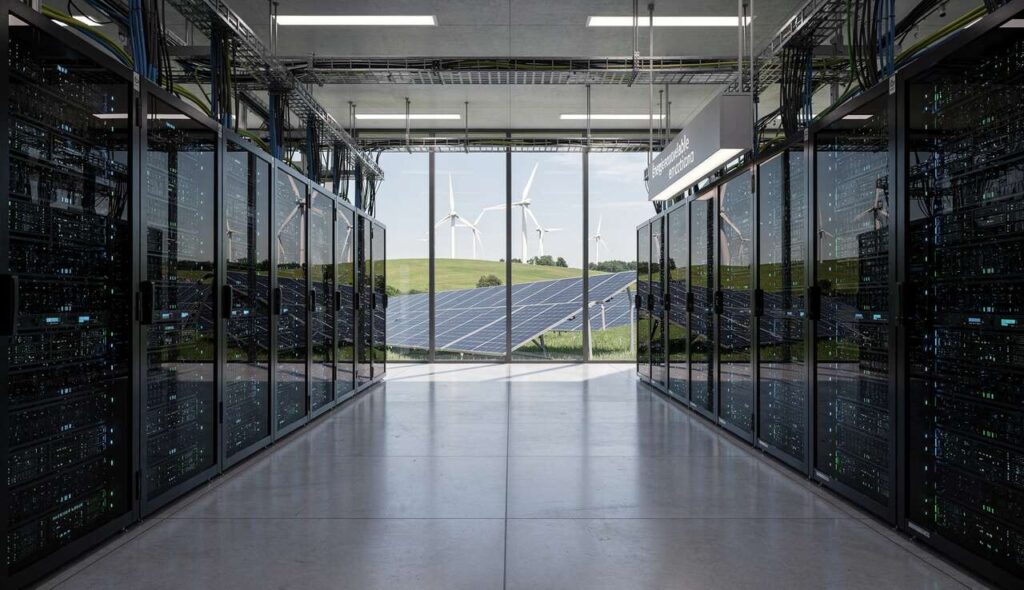
The tech industry’s rapid expansion into artificial intelligence has brought unprecedented computational demands, with data centres consuming staggering amounts of electricity to power machine learning algorithms and neural networks. Microsoft has announced a groundbreaking commitment to shoulder the entire energy costs associated with its AI-driven data centres, marking a significant shift in how major technology companies approach both environmental responsibility and operational expenses. This pledge represents more than a financial undertaking: it signals a recognition that the carbon footprint of artificial intelligence cannot be ignored as the technology becomes increasingly embedded in everyday applications. The company’s decision comes at a critical juncture when energy consumption by data centres worldwide continues to escalate, raising questions about sustainability and corporate accountability in the digital age.
Microsoft’s commitment to green energy
A comprehensive renewable energy strategy
Microsoft has positioned itself as a leader in corporate sustainability by pledging to transition all its data centre operations to renewable energy sources. The company’s strategy encompasses several key initiatives designed to eliminate reliance on fossil fuels whilst maintaining the computational power necessary for advanced AI applications. This commitment extends beyond mere carbon offsetting, focusing instead on direct procurement of clean energy through long-term power purchase agreements with wind and solar farms across multiple continents.
The technology giant has established specific targets that include:
- Achieving 100% renewable energy supply for all data centres by 2025
- Investing in on-site solar installations and battery storage systems
- Partnering with utility companies to develop dedicated renewable energy infrastructure
- Implementing advanced energy management systems to optimise consumption patterns
Financial implications of full cost coverage
By committing to cover complete power costs for AI data centres, Microsoft assumes a substantial financial burden that could reach billions annually. This decision reflects a strategic calculation that the long-term benefits of sustainable operations outweigh short-term expenses. The company anticipates that economies of scale in renewable energy procurement, combined with technological advances in energy efficiency, will eventually reduce the overall cost differential between conventional and green power sources.
| Cost Category | Traditional Energy | Renewable Energy |
|---|---|---|
| Initial Infrastructure | Lower | Higher |
| Operational Expenses | Variable | Predictable |
| Long-term Stability | Uncertain | Guaranteed |
This financial commitment also serves as a competitive differentiator, potentially attracting environmentally conscious enterprise clients who seek cloud service providers with demonstrable sustainability credentials. Understanding the scale of energy consumption requires examining the unique demands placed on modern data infrastructure.
Data centers: an energy challenge
The scale of computational power requirements
Contemporary data centres operate as massive energy consumers, with facilities housing thousands of servers running continuously to process, store, and transmit information. AI workloads intensify these demands exponentially, as machine learning models require parallel processing across multiple graphics processing units that draw considerably more electricity than traditional computing tasks. A single large-scale data centre can consume as much power as a small city, with cooling systems alone accounting for approximately 40% of total energy usage.
Infrastructure complexity and power distribution
The architecture of modern data centres presents significant engineering challenges in power management. Redundant power supplies, uninterruptible power systems, and backup generators ensure continuous operation, but these safety measures further increase overall energy consumption. Microsoft’s facilities incorporate sophisticated power distribution networks that must balance load across thousands of individual components whilst maintaining strict uptime requirements that often exceed 99.99% availability.
- High-density server racks generating concentrated heat loads
- Cooling infrastructure requiring substantial electrical input
- Network equipment maintaining constant connectivity
- Security systems and environmental controls operating continuously
These operational realities create a pressing need to address not just energy quantity but also the environmental consequences of such intensive consumption patterns.
The environmental impact of AI data centers
Carbon emissions and climate considerations
The environmental footprint of AI-powered data centres extends far beyond simple electricity consumption. When powered by conventional energy grids reliant on fossil fuels, these facilities contribute significantly to greenhouse gas emissions. Research indicates that the information and communications technology sector accounts for approximately 2-3% of global carbon emissions, with data centres representing a substantial portion of that total. As AI adoption accelerates, this percentage threatens to increase unless proactive measures are implemented.
Water consumption and resource depletion
Beyond carbon concerns, data centres utilise enormous quantities of water for cooling purposes, particularly in regions where air cooling proves insufficient. Microsoft’s commitment must therefore address not only energy sources but also water efficiency and conservation. Some facilities employ evaporative cooling systems that can consume millions of litres daily, placing strain on local water resources in areas already facing scarcity challenges.
| Environmental Factor | Impact Level | Mitigation Priority |
|---|---|---|
| Carbon Emissions | High | Critical |
| Water Usage | Moderate to High | Important |
| Land Use | Moderate | Moderate |
| Electronic Waste | Moderate | Important |
Addressing these multifaceted environmental challenges requires implementing comprehensive strategies that go beyond simply switching energy suppliers.
Microsoft’s strategies for responsible energy consumption
Technological innovations in efficiency
Microsoft has deployed cutting-edge technologies to reduce the energy intensity of its AI operations without compromising computational performance. Advanced cooling techniques, including liquid immersion systems and free-air cooling in suitable climates, dramatically reduce the power required for thermal management. The company has also invested heavily in custom-designed server hardware optimised specifically for AI workloads, achieving greater processing efficiency per watt consumed.
- Machine learning algorithms that optimise server utilisation in real-time
- Intelligent workload distribution to minimise idle capacity
- Heat recovery systems that repurpose waste thermal energy
- Next-generation chip architectures with improved power efficiency ratios
Partnerships and renewable energy procurement
The company has established strategic partnerships with renewable energy developers worldwide, signing power purchase agreements that guarantee long-term supply whilst supporting the expansion of clean energy infrastructure. These agreements often involve Microsoft committing to purchase electricity from facilities before they are constructed, providing developers with the financial certainty needed to secure project financing. This approach accelerates the deployment of renewable capacity beyond what market forces alone would achieve.
Such comprehensive strategies inevitably raise questions about the broader economic implications of transitioning entire data centre operations to sustainable energy models.
The economic stakes of a complete energy transition
Investment requirements and cost projections
Transitioning to 100% renewable energy for AI data centres requires substantial capital investment in both energy procurement infrastructure and facility upgrades. Microsoft’s commitment involves expenditures spanning renewable energy contracts, on-site generation capacity, energy storage systems, and grid connectivity enhancements. Industry analysts estimate that complete decarbonisation of large-scale data centre operations could require investments exceeding tens of billions of pounds across the technology sector.
Competitive advantages and market positioning
Despite the significant costs, Microsoft’s energy commitment offers strategic business advantages that extend beyond environmental stewardship. Regulatory pressures are intensifying globally, with governments implementing stricter emissions standards and carbon pricing mechanisms that will penalise companies relying on fossil fuels. By proactively addressing these requirements, Microsoft positions itself favourably for future regulatory environments whilst potentially avoiding substantial compliance costs and operational restrictions.
Looking ahead, the technology industry faces crucial decisions about how sustainable practices will shape the next generation of cloud computing infrastructure.
Future perspectives for a sustainable cloud
Industry-wide implications and standards
Microsoft’s commitment may establish new industry benchmarks that competitors feel compelled to match, potentially triggering a transformation across the entire cloud computing sector. As major technology companies announce similar pledges, collective action could accelerate the renewable energy transition whilst driving down costs through increased demand and economies of scale. This competitive dynamic might ultimately benefit the broader economy by stimulating investment in clean energy infrastructure and creating employment opportunities in emerging green technology sectors.
Technological horizons and emerging solutions
Future advancements promise to further reduce the environmental impact of AI data centres through breakthrough innovations in computing architecture and energy systems. Quantum computing, neuromorphic chips, and other novel approaches could dramatically decrease the energy required for complex computational tasks. Additionally, developments in energy storage technology, including next-generation batteries and hydrogen fuel cells, may enable data centres to operate independently of grid constraints whilst maintaining continuous renewable power supply.
Microsoft’s bold commitment to covering full power costs for its energy-intensive AI data centres represents a watershed moment in corporate environmental responsibility within the technology sector. The company’s comprehensive approach addresses not only the immediate challenge of reducing carbon emissions but also the broader imperative to develop sustainable infrastructure capable of supporting continued AI advancement. By assuming complete financial responsibility for energy expenses whilst transitioning to renewable sources, Microsoft demonstrates that environmental stewardship and technological innovation need not be mutually exclusive objectives. The success of this initiative will likely influence industry practices for years to come, potentially establishing new standards for how technology companies balance computational demands with ecological accountability. As artificial intelligence becomes increasingly central to economic activity and daily life, the precedent set by such commitments will prove crucial in determining whether the digital transformation can proceed without exacerbating climate challenges.