



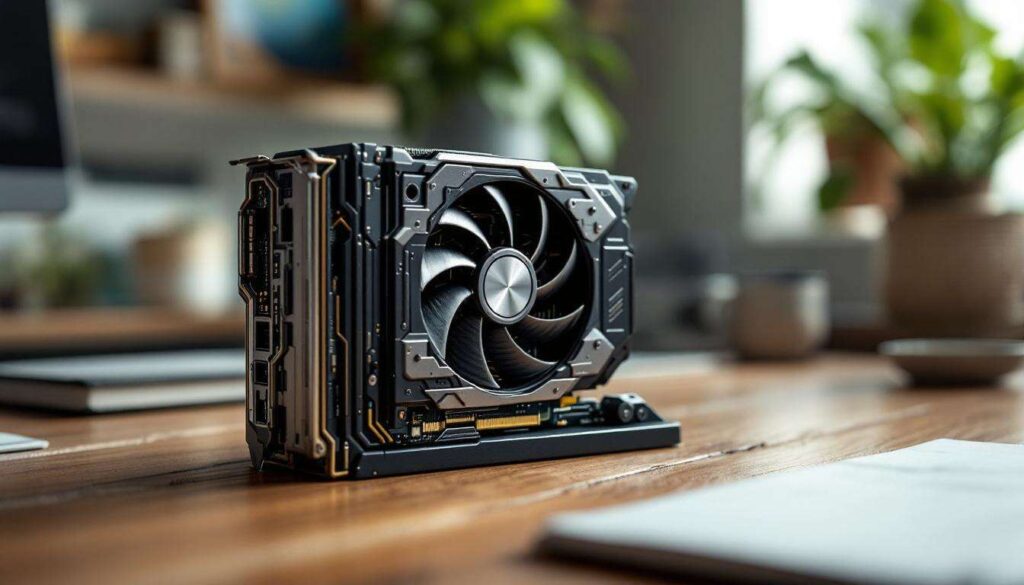
Graphics cards have a limited lifespan in the fast-paced world of gaming and professional computing. When newer models arrive with enhanced capabilities, older units often find themselves relegated to storage or disposal. However, these components retain significant processing power and can serve numerous practical purposes beyond their original gaming functions. Rather than contributing to electronic waste, repurposing old graphics cards offers both environmental and financial benefits whilst opening doors to innovative projects that leverage their computational strengths.
Optimise your PC for video rendering
Video editing and rendering remain resource-intensive tasks that benefit tremendously from dedicated graphics processing units. An older graphics card can dramatically reduce rendering times compared to relying solely on integrated graphics or CPU processing.
Accelerating editing workflows with GPU support
Modern video editing software such as Adobe Premiere Pro, DaVinci Resolve, and Final Cut Pro all support GPU acceleration. By installing your old graphics card as a secondary unit, you create a dedicated rendering pipeline that frees your primary GPU for real-time preview work. This configuration proves particularly valuable for content creators working with 4K footage or applying complex colour grading effects.
The benefits extend beyond simple speed improvements:
- Reduced heat generation on your primary GPU during extended rendering sessions
- Ability to continue gaming or other GPU-intensive tasks whilst rendering in the background
- Enhanced stability when processing multiple video streams simultaneously
- Lower electricity costs compared to running high-end modern cards at full capacity
Setting up dedicated encoding stations
For those managing large video libraries or streaming content, an old graphics card can transform a spare computer into a dedicated encoding station. The NVENC encoder found in NVIDIA cards or VCE in AMD models handles video compression efficiently, making format conversions and streaming preparation considerably faster than software-based solutions.
Understanding how graphics cards enhance multimedia production naturally leads to their potential in networked entertainment systems.
Create a home gaming server
Building a dedicated gaming server transforms how households experience multiplayer entertainment. An old graphics card provides the necessary horsepower for hosting game sessions without monopolising your primary gaming machine.
Hosting multiplayer sessions locally
Popular titles such as Minecraft, Valheim, and ARK: Survival Evolved benefit from dedicated server hosting. Your retired graphics card can power a server machine that maintains persistent game worlds, allowing friends and family to connect anytime. This approach offers superior performance compared to peer-to-peer hosting and eliminates the need for expensive third-party server rentals.
| Server Type | Monthly Cost (Rental) | Old GPU Solution |
|---|---|---|
| Minecraft (20 players) | £15-25 | One-time setup |
| ARK Server | £20-35 | One-time setup |
| Valheim Server | £10-18 | One-time setup |
Streaming and remote gaming capabilities
Beyond traditional server hosting, old graphics cards excel at powering Steam Remote Play or Parsec streaming setups. These configurations allow you to stream games from a central machine to less powerful devices throughout your home, effectively extending your gaming library to laptops, tablets, or older computers.
Gaming applications represent just one facet of computational repurposing, with financial technologies offering another compelling avenue.
Use the card for cryptocurrency mining
Cryptocurrency mining remains a controversial yet viable application for older graphics cards, though realistic expectations are essential given current market conditions and energy costs.
Understanding profitability and limitations
Modern cryptocurrency mining has evolved significantly, with proof-of-work algorithms requiring substantial computational resources. Older graphics cards typically generate modest returns, particularly after accounting for electricity consumption. However, certain altcoins remain accessible to legacy hardware, and mining can serve as a learning experience rather than purely a profit venture.
Key considerations include:
- Electricity costs in your region versus potential mining rewards
- Heat generation and adequate cooling requirements
- Wear on hardware components from continuous operation
- Selecting appropriate cryptocurrencies that match your card’s capabilities
Alternative blockchain applications
Beyond traditional mining, older GPUs can participate in distributed computing projects that reward participants with cryptocurrency. Platforms such as Golem Network allow users to rent out computing power for rendering tasks, whilst Folding@Home combines scientific research with token rewards.
Whilst financial applications capture attention, scientific endeavours offer equally rewarding opportunities for repurposed hardware.
Transform into a scientific computation tool
Graphics cards excel at parallel processing tasks, making them invaluable for scientific research and computational modelling that extends far beyond entertainment applications.
Participating in distributed research projects
Numerous scientific initiatives welcome contributions from volunteer computing resources. Your old graphics card can assist with protein folding simulations, climate modelling, or astronomical data analysis through platforms such as BOINC (Berkeley Open Infrastructure for Network Computing). These projects leverage GPU acceleration to process vast datasets, with participants contributing to genuine scientific breakthroughs.
Notable projects accepting GPU contributions include:
- Einstein@Home for gravitational wave detection
- Rosetta@Home for protein structure prediction
- GPUGrid for molecular dynamics simulations
- SETI@Home archives for extraterrestrial intelligence research
Personal computational experiments
For those with programming knowledge, old graphics cards provide an accessible platform for learning CUDA or OpenCL programming. These parallel computing frameworks power everything from weather prediction to financial modelling, and experimenting with older hardware offers a low-risk environment for developing valuable technical skills.
Scientific computing shares conceptual foundations with another rapidly expanding field that demands similar processing capabilities.
Set up an artificial intelligence project
Artificial intelligence and machine learning represent perhaps the most exciting applications for repurposed graphics cards, offering hands-on experience with technologies shaping modern society.
Machine learning experimentation
Training neural networks requires substantial parallel processing power, precisely what graphics cards provide. Older models remain perfectly capable of running TensorFlow, PyTorch, or Keras for educational projects and small-scale model training. Whilst professional AI development demands cutting-edge hardware, learning fundamentals and prototyping ideas works exceptionally well on legacy equipment.
Practical AI projects suitable for older GPUs include:
- Image classification systems using convolutional neural networks
- Natural language processing experiments with smaller datasets
- Reinforcement learning agents for game-playing algorithms
- Style transfer applications for artistic image manipulation
Building computer vision applications
Computer vision tasks such as object detection, facial recognition, and motion tracking benefit enormously from GPU acceleration. An old graphics card can power home security systems, wildlife monitoring setups, or interactive art installations that respond to human presence and movement.
Technical applications demonstrate impressive capabilities, yet creative and educational uses often prove equally valuable for communities and individuals.
Recycle for artistic and educational projects
Beyond computational applications, old graphics cards serve important roles in education and creative expression, bridging technology with community engagement.
Educational institutions and maker spaces
Schools, colleges, and community workshops frequently lack funding for modern computing equipment. Donating functional graphics cards to these organisations provides students with hands-on experience in computer assembly, programming, and digital media creation. Technical education programmes particularly benefit from hardware donations, as students gain practical skills working with real components rather than purely theoretical knowledge.
Artistic installations and physical projects
The maker movement has embraced repurposed electronics for creative expression. Graphics cards can power LED matrix displays, interactive sculptures, or generative art installations that combine visual aesthetics with computational processing. Even non-functional cards find new life as components in steampunk artwork or educational displays demonstrating computer architecture.
Repurposing old graphics cards extends their useful life whilst reducing electronic waste and opening doors to diverse technical and creative pursuits. Whether accelerating video production, hosting game servers, contributing to scientific research, exploring artificial intelligence, or supporting educational initiatives, these components retain significant value beyond their original gaming purpose. The approaches outlined demonstrate that technological obsolescence often reflects changing requirements rather than absolute limitations, encouraging thoughtful consideration before discarding functional hardware.