


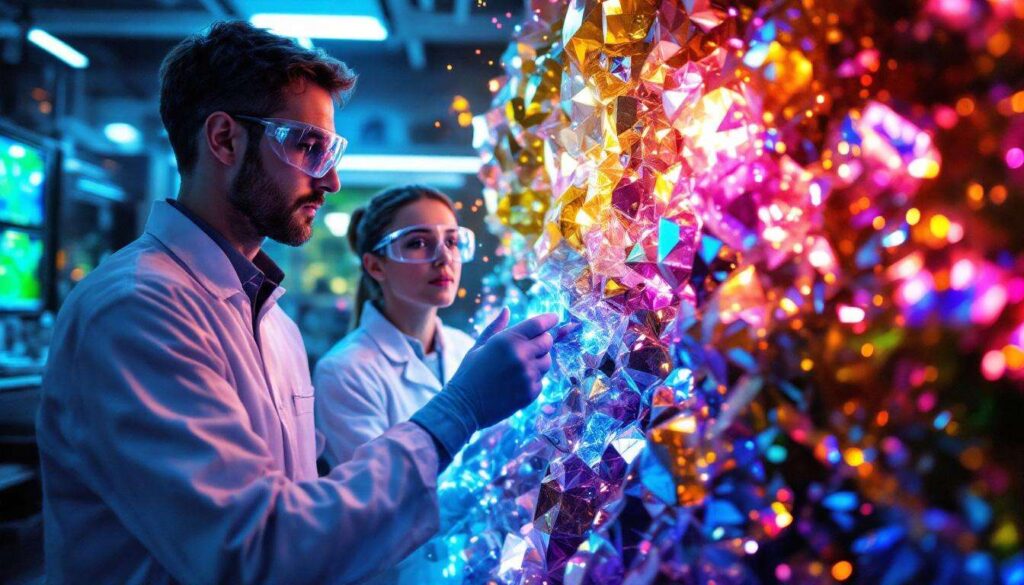
Researchers have achieved a remarkable breakthrough by creating the first visible time crystal, a phenomenon that challenges our fundamental understanding of matter and energy. This extraordinary development marks a significant milestone in quantum physics, bringing what was once purely theoretical into the realm of observable reality.
Discovery of the visible time crystal
The creation of the first visible time crystal represents a pivotal moment in experimental physics. Unlike previous time crystals that existed only at microscopic scales or required sophisticated detection equipment, this new iteration can be observed with the naked eye. Scientists at leading research institutions have successfully scaled up the phenomenon, making it accessible to direct observation.
The experimental setup
The research team employed an innovative combination of laser systems and carefully controlled environments to achieve this unprecedented result. The experimental apparatus included:
- High-precision optical lasers operating at specific frequencies
- Ultra-stable temperature control systems maintaining near-absolute zero conditions
- Magnetic field generators providing consistent quantum states
- Advanced imaging systems capable of capturing temporal patterns
The visible time crystal manifests as a rhythmic pattern of light and shadow, pulsating at regular intervals without any apparent energy input. This self-sustaining oscillation continues indefinitely, defying conventional thermodynamic expectations.
Verification and validation
To confirm the authenticity of their discovery, researchers conducted extensive verification protocols. The team measured the crystal’s behaviour over extended periods, documenting its consistent temporal patterns. Multiple independent laboratories have since replicated the results, establishing scientific consensus on the phenomenon’s legitimacy.
Understanding what this visible manifestation means requires examining the fundamental nature of time crystals themselves.
What a time crystal is
A time crystal represents a unique phase of matter that exhibits periodic motion in time whilst remaining in its ground energy state. This concept, first proposed by Nobel laureate Frank Wilczek in 2012, fundamentally differs from conventional crystals.
Comparison with ordinary crystals
| Property | Ordinary Crystal | Time Crystal |
|---|---|---|
| Symmetry breaking | Spatial | Temporal |
| Pattern repetition | In space | In time |
| Energy requirement | Minimal energy state | Ground state with motion |
| Equilibrium status | Static equilibrium | Dynamic non-equilibrium |
Ordinary crystals arrange their atoms in repeating patterns through space, creating structures like diamonds or salt. Time crystals, conversely, exhibit patterns that repeat through time, with their structure oscillating between different configurations at regular intervals.
Breaking time-translation symmetry
The defining characteristic of time crystals involves breaking time-translation symmetry. This principle states that the laws of physics remain constant over time. However, time crystals spontaneously develop a preferred rhythm, creating a temporal structure that repeats periodically. This doesn’t violate physical laws but rather demonstrates a new way matter can organise itself.
The mechanics behind this extraordinary behaviour reveal even more fascinating details about quantum systems.
How a time crystal works
The operation of a time crystal relies on quantum mechanical principles that allow systems to maintain perpetual motion without energy loss. This seemingly impossible feat becomes achievable through specific conditions and interactions.
Quantum coherence and many-body interactions
Time crystals function through many-body quantum coherence, where numerous particles interact in coordinated ways. The system maintains coherence through:
- Quantum entanglement between constituent particles
- Periodic driving forces that maintain the system’s rhythm
- Protection from environmental decoherence through isolation
- Specific symmetry properties that prevent energy absorption
The visible time crystal operates by exploiting optical transitions in specially prepared atomic systems. Atoms within the crystal absorb and emit photons in synchronised patterns, creating the observable pulsations. This process occurs without net energy gain or loss, maintaining the system’s ground state.
Stability mechanisms
Several factors contribute to the remarkable stability of time crystals. The phenomenon resists perturbations through topological protection, a quantum property that makes the temporal pattern robust against minor disturbances. Additionally, the periodic driving force locks the system into its oscillating state, preventing decay into thermal equilibrium.
These unique properties open up numerous possibilities for practical applications across various fields.
Potential impact of time crystals
The creation of visible time crystals carries profound implications for multiple scientific and technological domains. This breakthrough could revolutionise our approach to information processing, timekeeping, and fundamental physics research.
Quantum computing advantages
Time crystals offer exceptional promise for quantum computing applications. Their inherent stability against decoherence addresses one of quantum computing’s most significant challenges. Potential benefits include:
- Extended coherence times for quantum bits
- Reduced error rates in quantum calculations
- Novel quantum memory architectures
- Enhanced quantum sensing capabilities
Precision measurement tools
The regular, self-sustaining oscillations of time crystals could enable unprecedented precision in timekeeping and measurement. These systems might surpass current atomic clocks, providing more accurate time standards for navigation, telecommunications, and scientific research.
Fundamental physics insights
Beyond practical applications, time crystals provide a testing ground for fundamental physics theories. They offer opportunities to explore non-equilibrium thermodynamics, quantum phase transitions, and the nature of time itself. Researchers can investigate questions about entropy, reversibility, and the arrow of time using these systems.
Looking ahead, scientists envision numerous ways to harness these remarkable properties.
Future applications of time crystals
The visible nature of the newly created time crystal accelerates the timeline for practical implementations. Researchers are actively exploring several promising directions for future development.
Energy-efficient technologies
Time crystals could inspire revolutionary approaches to energy management. Their ability to maintain motion without energy dissipation suggests possibilities for ultra-low-power devices and perpetual sensors that require minimal maintenance.
Advanced communication systems
Telecommunications could benefit from time crystal-based components that provide stable, synchronised signals. Applications might include:
- Ultra-precise frequency standards for wireless networks
- Quantum communication protocols with enhanced security
- Synchronisation systems for distributed computing
- Novel modulation schemes for data transmission
Medical and biological applications
The visibility of these time crystals opens possibilities for biological and medical research. Scientists could develop non-invasive imaging techniques or create quantum sensors for detecting minute biological signals. The stable oscillations might also find use in targeted drug delivery systems or cellular-level diagnostics.
The successful creation of a visible time crystal demonstrates that theoretical predictions can manifest as observable reality. This achievement not only validates decades of theoretical work but also establishes a foundation for exploring new phases of matter. As researchers continue refining these systems and developing applications, time crystals promise to reshape our technological landscape whilst deepening our understanding of the quantum world. The journey from mathematical concept to visible phenomenon illustrates the remarkable progress in experimental physics and hints at the transformative discoveries that await.