



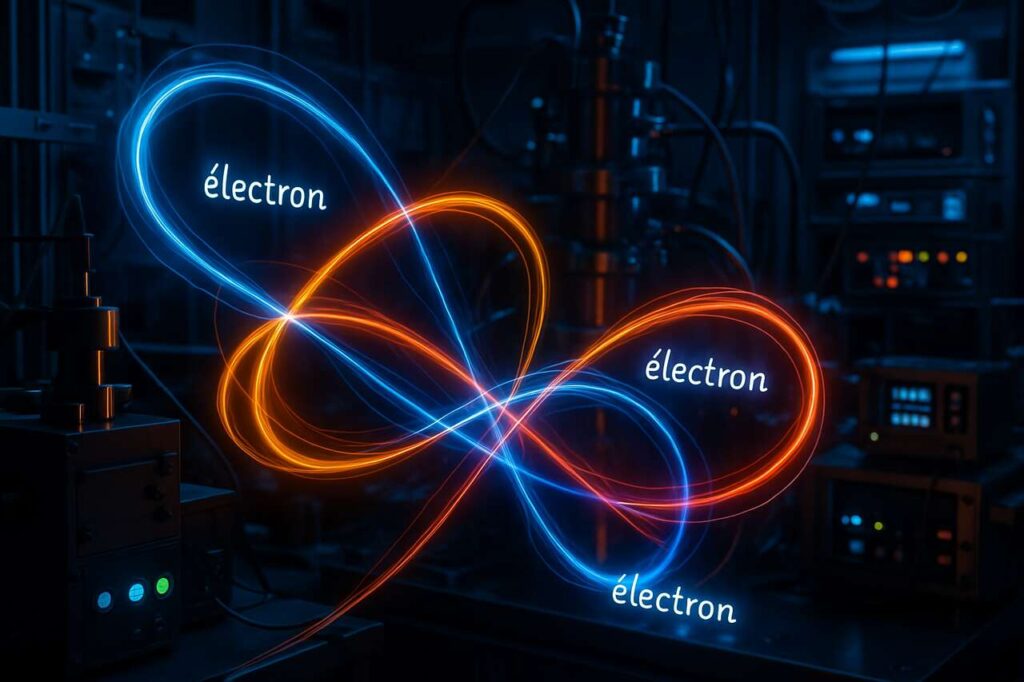
Quantum physics continues to challenge our understanding of matter and energy at the smallest scales. Recent experimental work has uncovered a remarkable phenomenon where electrons exhibit behaviour that defies conventional quantum mechanical predictions. This breakthrough observation reveals a state of matter in which electrons appear to move with unprecedented freedom, creating what researchers describe as a fundamentally new quantum phase. The discovery emerged from sophisticated laboratory experiments designed to probe the limits of electron behaviour under extreme conditions. By manipulating materials at near-absolute-zero temperatures and applying precise electromagnetic fields, scientists have documented electron dynamics that cannot be explained by existing theoretical frameworks. This finding promises to reshape how physicists conceptualise quantum states and could unlock pathways to revolutionary technologies.
Introduction to the new quantum state
Defining the quantum phase
The newly identified quantum state represents a departure from traditional electron organisation within materials. In conventional quantum systems, electrons occupy well-defined energy levels and follow predictable patterns governed by quantum mechanics. However, this novel state demonstrates characteristics where electrons exhibit collective behaviour that appears chaotic yet maintains quantum coherence. The phenomenon occurs when specific conditions suppress the normal constraints that restrict electron movement, allowing them to explore a vastly expanded range of configurations.
Experimental conditions required
Creating this quantum state demands extraordinarily precise environmental control. Researchers achieved the necessary conditions through:
- cooling materials to temperatures below 0.1 Kelvin
- applying carefully calibrated magnetic fields
- using ultra-pure crystalline structures
- isolating samples from external electromagnetic interference
These stringent requirements explain why the state remained unobserved until sophisticated cryogenic and measurement technologies became available. The delicate nature of the quantum phase means that even minute disturbances can cause the system to collapse back into conventional behaviour.
Understanding the foundational characteristics of this quantum state sets the stage for examining how physicists made this remarkable discovery.
Exceptional discovery by physicists
Research methodology
The breakthrough emerged from a collaborative effort involving multiple research institutions equipped with cutting-edge quantum measurement apparatus. Scientists employed advanced spectroscopic techniques to observe electron behaviour with unprecedented temporal and spatial resolution. By monitoring how electrons responded to precisely controlled perturbations, the team identified anomalous signatures that indicated a transition into an unknown quantum phase.
Key observations
The experimental data revealed several distinctive features:
- electron mobility increased by orders of magnitude
- quantum entanglement patterns differed from all known states
- energy dissipation rates dropped to near-zero levels
- coherence times extended far beyond theoretical predictions
These observations collectively pointed towards a fundamentally new organisational principle governing electron behaviour. The researchers documented their findings through multiple independent measurement techniques, ensuring the reliability of their conclusions.
Verification process
Scientific rigour demanded extensive verification before announcing the discovery. The team repeated experiments across different material systems and temperature ranges, consistently reproducing the characteristic signatures of the new quantum state. Peer review by independent laboratories confirmed the observations, establishing the phenomenon as a genuine addition to the catalogue of quantum phases.
Having established the credibility of the discovery, attention naturally turns to what this means for the broader field of physics.
Implications for modern physics
Theoretical challenges
The new quantum state presents significant challenges to existing theoretical frameworks. Current models of electron behaviour in condensed matter systems cannot fully account for the observed dynamics. Physicists must now develop enhanced mathematical descriptions that incorporate the unusual freedom electrons display in this phase. This theoretical work may require revisiting fundamental assumptions about quantum many-body interactions and the constraints that typically govern electron systems.
Connections to other phenomena
The discovery potentially illuminates connections between previously disparate areas of physics. Researchers have identified possible links to:
- high-temperature superconductivity mechanisms
- quantum Hall effect variations
- topological phases of matter
- quantum critical points
These connections suggest that understanding the new state could provide insights into longstanding puzzles in condensed matter physics and potentially resolve contradictions between experimental observations and theoretical predictions.
With the theoretical landscape evolving, examining the specific mechanisms behind electron behaviour becomes essential.
Functioning of electrons in this new state
Electron dynamics
In this quantum phase, electrons exhibit collective motion that resembles fluid flow more than the discrete hopping typically observed in solids. The usual localisation effects that confine electrons to specific regions become suppressed, allowing them to explore the material with remarkable freedom. This delocalised behaviour occurs whilst maintaining quantum coherence across macroscopic distances, a combination rarely observed in nature.
Energy considerations
The energy landscape experienced by electrons in this state differs fundamentally from conventional quantum systems. Rather than occupying discrete energy levels, electrons access a continuum of states with minimal energy barriers between configurations. This flattening of the energy spectrum enables the observed mobility whilst preventing thermal excitations from disrupting the quantum phase.
Comparison with conventional states
| Property | Conventional state | New quantum state |
|---|---|---|
| Electron mobility | Restricted | Highly enhanced |
| Coherence time | Nanoseconds | Microseconds |
| Energy dissipation | Moderate | Negligible |
These stark contrasts highlight why the new state represents such a significant departure from established quantum behaviour.
Understanding these mechanisms naturally leads to considering how this discovery might be harnessed for practical purposes.
Potential applications and technological advancements
Quantum computing possibilities
The extended coherence times and reduced energy dissipation make this quantum state particularly attractive for quantum computing applications. Electrons in this phase could serve as robust quantum bits that maintain superposition states far longer than current technologies allow. This stability would address one of the primary obstacles preventing large-scale quantum computers from becoming practical.
Energy transmission innovations
The near-frictionless electron movement suggests applications in ultra-efficient energy transmission. Materials engineered to support this quantum state could transport electrical current with minimal losses, revolutionising power distribution networks and electronic device efficiency.
Sensing technologies
The sensitivity of the quantum state to external perturbations could enable:
- ultra-precise magnetic field sensors
- quantum-enhanced measurement devices
- novel medical imaging techniques
- gravitational wave detectors with improved resolution
These applications would leverage the unique properties of the electron state to achieve measurement capabilities beyond current technological limits.
As these possibilities emerge, the scientific community has responded with considerable interest and scrutiny.
Reactions from the scientific community
Expert assessments
Leading physicists have characterised the discovery as groundbreaking, with several prominent researchers describing it as one of the most significant findings in condensed matter physics this decade. The work has sparked intense discussion at international conferences and generated numerous follow-up studies aimed at exploring the boundaries and characteristics of the new quantum phase.
Ongoing research initiatives
Multiple research groups have launched investigations to:
- identify additional materials capable of hosting the state
- develop theoretical models explaining the observations
- explore variations of the quantum phase
- investigate practical implementation challenges
This collaborative momentum suggests that understanding and harnessing the new quantum state will remain a priority for the physics community in coming years.
The revelation of this quantum state where electrons display unprecedented freedom marks a pivotal moment in our understanding of matter. The discovery challenges existing theoretical frameworks whilst opening pathways to transformative technologies in computing, energy, and sensing. As researchers continue investigating this phenomenon, the full implications for both fundamental physics and practical applications will gradually emerge, potentially reshaping multiple technological domains and deepening our comprehension of quantum mechanics at its most fundamental level.