



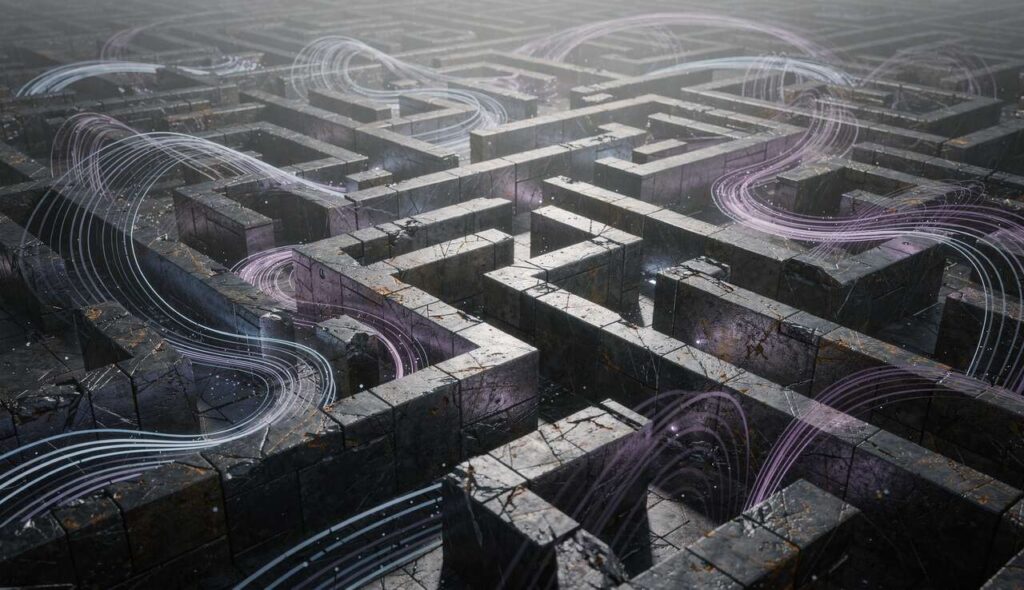
Physicists have long grappled with the peculiar behaviour of frustrated magnets, materials where competing magnetic interactions prevent atoms from settling into a simple, ordered arrangement. These exotic substances exhibit properties that challenge conventional understanding and hold promise for next-generation technologies. Recent breakthroughs demonstrate how artificial intelligence has cracked open problems that have stymied researchers for decades, offering unprecedented insights into these complex quantum systems.
Introduction to frustrated magnets
Understanding magnetic frustration
Frustrated magnets represent a fascinating class of materials where geometric constraints prevent magnetic moments from achieving their lowest energy state. Unlike ordinary magnets where atomic spins align neatly, frustrated systems contain competing interactions that create an irresolvable conflict. This phenomenon occurs when the arrangement of atoms makes it impossible for all magnetic interactions to be simultaneously satisfied.
The concept derives from geometric frustration, typically observed in triangular or tetrahedral lattice structures. Consider three magnetic atoms arranged in a triangle, each preferring to align antiparallel to its neighbours. While the first two atoms can orient themselves oppositely, the third atom faces an impossible choice, as it cannot simultaneously oppose both neighbours.
Physical properties and applications
These materials exhibit remarkable characteristics that distinguish them from conventional magnetic systems:
- Highly degenerate ground states with numerous energy configurations
- Exotic phases of matter including spin liquids and spin ice
- Unusual thermal and magnetic responses at low temperatures
- Potential applications in quantum computing and information storage
Frustrated magnets maintain their disordered state even at temperatures approaching absolute zero, defying the typical tendency of materials to crystallise into ordered structures. This persistent disorder creates a rich landscape of quantum phenomena that researchers have struggled to map comprehensively.
Understanding these fundamental properties has proven essential for developing technologies that exploit quantum mechanical effects, yet the complexity of these systems has historically made theoretical predictions extraordinarily challenging.
The maze impasse: a decades-long challenge
Computational barriers in traditional physics
For more than thirty years, physicists have confronted what many describe as a computational maze when attempting to model frustrated magnetic systems. The core difficulty stems from the exponential growth of possible configurations as system size increases. A modest frustrated magnet containing just fifty atoms presents more potential states than can be practically enumerated using conventional computational methods.
Traditional approaches relied on approximations and simplified models that often failed to capture the essential physics. Monte Carlo simulations, whilst useful, frequently became trapped in local energy minima, unable to explore the full landscape of possible configurations. Exact diagonalisation techniques remained limited to systems of fewer than forty spins, far too small to observe many emergent phenomena.
The complexity conundrum
| System size (atoms) | Possible configurations | Classical computing time |
|---|---|---|
| 20 | ~1 million | Minutes |
| 50 | ~1015 | Years |
| 100 | ~1030 | Beyond universe age |
This combinatorial explosion created an insurmountable barrier. Researchers could neither verify theoretical predictions against experimental observations nor design new materials with desired properties. The field reached a frustrating stalemate where experimental capabilities outpaced theoretical understanding, leaving numerous puzzling observations unexplained.
The impasse demanded entirely new approaches that could navigate this computational labyrinth efficiently.
Revolutionary role of AI in physics
Machine learning enters the quantum realm
Artificial intelligence has transformed the landscape of frustrated magnet research by introducing novel computational strategies that sidestep traditional limitations. Neural networks, particularly those employing deep learning architectures, have demonstrated remarkable ability to represent complex quantum states using far fewer parameters than conventional methods require.
The breakthrough emerged from recognising that AI systems excel at identifying patterns within high-dimensional data, precisely the challenge presented by frustrated magnets. Rather than exhaustively calculating every possible configuration, machine learning algorithms learn to recognise which regions of the configuration space contain the most physically relevant information.
Synergy between physics and computing
The integration of AI into physics research represents more than simply applying existing tools to new problems. Physicists have developed specialised neural network architectures that incorporate fundamental physical principles:
- Symmetry-aware networks that respect conservation laws
- Variational autoencoders designed for quantum state representation
- Reinforcement learning agents that optimise search strategies
- Generative models capable of proposing novel material configurations
These physics-informed AI systems achieve accuracies that match or exceed traditional methods whilst requiring orders of magnitude less computational resources. They have successfully predicted ground state properties, phase transitions, and excitation spectra for systems previously considered intractable.
This powerful combination of domain expertise and computational innovation has opened pathways that were previously invisible to researchers.
Algorithms at the heart of innovations
Neural quantum states
One of the most significant advances involves neural quantum states, where artificial neural networks directly represent the wavefunction of a many-body quantum system. This approach compresses the exponentially large amount of information required to describe a quantum state into a manageable neural network with trainable parameters.
The network learns to approximate the ground state by minimising the energy expectation value, effectively solving the Schrödinger equation through optimisation. Convolutional neural networks prove particularly effective for systems with spatial structure, whilst recurrent architectures handle systems with long-range correlations.
Reinforcement learning for configuration sampling
Complementing neural quantum states, reinforcement learning algorithms have revolutionised how researchers sample the configuration space of frustrated magnets. These agents learn optimal strategies for exploring the energy landscape, avoiding the traps that ensnared traditional Monte Carlo methods.
| Algorithm type | Primary advantage | Best application |
|---|---|---|
| Neural quantum states | Compact representation | Ground state properties |
| Reinforcement learning | Efficient sampling | Finite temperature behaviour |
| Generative models | Novel structure prediction | Material design |
The algorithms continuously improve their performance through experience, developing intuition about which configurations merit detailed investigation. This adaptive approach dramatically accelerates convergence compared to traditional methods.
These algorithmic innovations have collectively dismantled barriers that stood for decades.
Surprising results and new perspectives
Solving long-standing puzzles
AI-powered analysis has resolved several contentious debates within the frustrated magnet community. For the kagome lattice antiferromagnet, a system studied intensively since the 1990s, neural network approaches definitively characterised the ground state, settling disagreements between competing theoretical predictions and reconciling them with experimental observations.
Perhaps most remarkably, these methods have identified previously unknown phases of matter. In certain three-dimensional frustrated systems, AI algorithms discovered intermediate phases that exist in narrow parameter ranges, phases that conventional techniques had completely overlooked due to their subtle signatures.
Unexpected physical insights
Beyond solving specific problems, AI has provided fresh perspectives on fundamental questions:
- Revealing universal scaling behaviours across different frustrated systems
- Identifying which microscopic interactions dominate macroscopic properties
- Uncovering hidden symmetries that simplify theoretical descriptions
- Predicting which materials will exhibit technologically useful properties
The interpretability of neural network decisions has emerged as an unexpected benefit. By analysing which features the networks prioritise, physicists gain intuition about the essential physics governing these systems, sometimes leading to simplified analytical models that capture the key phenomena.
These discoveries have reinvigorated a field that had reached apparent limits.
The future of frustrated magnet research
Accelerating materials discovery
The immediate future involves deploying AI systems to systematically screen candidate materials for desired properties. Rather than relying on serendipity or exhaustive experimentation, researchers can now computationally evaluate thousands of potential compounds, identifying the most promising candidates for synthesis and testing.
This capability proves particularly valuable for designing materials with specific technological applications. Quantum computing platforms require materials with precisely controlled magnetic properties, whilst next-generation data storage technologies demand substances that maintain information at room temperature despite their frustrated nature.
Expanding horizons
Looking further ahead, several exciting directions are emerging:
- Real-time experimental control guided by AI predictions
- Automated hypothesis generation and testing cycles
- Integration with quantum computing hardware for hybrid classical-quantum algorithms
- Extension to related problems in superconductivity and topological materials
The methodologies developed for frustrated magnets are already transferring to other challenging problems in condensed matter physics. The same neural network architectures that cracked the frustrated magnet puzzle now tackle high-temperature superconductors, strongly correlated electron systems, and topological phases.
Collaborative frameworks connecting experimentalists, theorists, and AI specialists promise to accelerate discovery further. As these tools become more accessible and user-friendly, they will democratise advanced computational physics, enabling smaller research groups to tackle questions previously reserved for major institutions.
The convergence of artificial intelligence and frustrated magnet physics has dismantled computational barriers that persisted for decades, transforming theoretical predictions from aspirational to achievable. Neural quantum states and reinforcement learning algorithms now routinely solve problems that were once considered intractable, revealing exotic phases of matter and resolving long-standing controversies. These advances extend beyond frustrated magnets, offering powerful methodologies applicable across condensed matter physics and materials science. As AI systems grow more sophisticated and physically informed, they promise not merely to accelerate existing research programmes but to fundamentally reshape how physicists approach complex quantum systems, opening pathways to technologies that exploit the strange and wonderful properties of frustrated magnetic materials.