



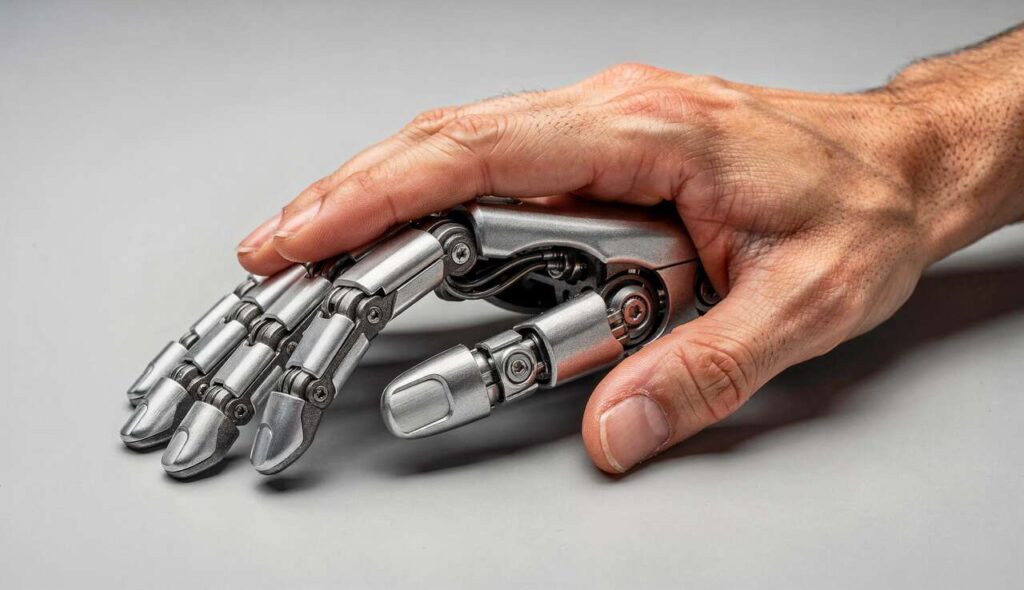
Human touch remains one of the most complex and nuanced forms of communication, conveying emotions, intentions and social bonds through the simple act of physical contact. From a reassuring hand on the shoulder to the gentle embrace of a loved one, tactile interaction forms an essential component of human experience. Yet despite remarkable advances in robotics and artificial intelligence, scientists and engineers continue to grapple with the challenge of recreating this seemingly straightforward sense in mechanical systems. The difficulty lies not merely in detecting pressure or temperature, but in capturing the subtlety, warmth and emotional resonance that characterise genuine human touch.
The power of human touch
Touch as fundamental communication
Physical contact serves as a primary channel of human communication, often conveying messages that words cannot adequately express. Research demonstrates that touch can communicate distinct emotions with remarkable accuracy, allowing individuals to identify feelings such as compassion, gratitude, anger and fear through tactile signals alone. This non-verbal language operates across cultural boundaries, though interpretations and social norms surrounding touch vary considerably between societies.
The significance of touch extends beyond emotional expression to include:
- Establishing trust and rapport in personal and professional relationships
- Reinforcing social bonds within families and communities
- Providing comfort during times of distress or uncertainty
- Enhancing learning and memory retention through physical interaction
- Facilitating cooperation and prosocial behaviour in group settings
Psychological and physiological benefits
The impact of human touch on wellbeing extends far beyond subjective comfort. Studies have documented measurable physiological changes resulting from positive tactile experiences, including reduced cortisol levels, decreased heart rate and lowered blood pressure. These effects contribute to stress reduction and improved immune function, highlighting the therapeutic potential of appropriate physical contact.
Healthcare professionals have long recognised the importance of touch in medical contexts, where a practitioner’s gentle examination can simultaneously diagnose conditions and provide reassurance to anxious patients. The absence of touch, conversely, has been linked to developmental delays in infants and psychological distress in adults, underscoring its fundamental role in human flourishing.
Understanding these profound effects raises important questions about whether artificial systems could ever provide comparable benefits, setting the stage for examining the underlying biological processes that make touch so powerful.
The biological mechanisms of touch
The complexity of mechanoreceptors
Human skin contains an intricate network of specialised receptors that detect various aspects of tactile stimulation. These mechanoreceptors differ in structure, location and function, enabling the perception of pressure, vibration, stretch and texture. Four primary types work in concert to create our tactile experience:
| Receptor type | Location | Primary function | Adaptation speed |
|---|---|---|---|
| Merkel cells | Superficial skin | Fine detail and texture | Slow |
| Meissner corpuscles | Superficial skin | Light touch and grip | Rapid |
| Ruffini endings | Deep skin | Skin stretch and joint position | Slow |
| Pacinian corpuscles | Deep skin | Vibration and pressure | Rapid |
Neural processing and interpretation
The journey from physical contact to conscious perception involves multiple stages of neural processing. Signals from mechanoreceptors travel through peripheral nerves to the spinal cord, then ascend to the brainstem and thalamus before reaching the somatosensory cortex. This pathway allows for rapid reflexive responses whilst simultaneously enabling sophisticated cognitive interpretation of tactile information.
The brain integrates touch with other sensory modalities, creating a unified perceptual experience. This multisensory integration explains why visual information about an object influences how we perceive its texture, and why the context of a touch dramatically affects its emotional interpretation. A tap on the shoulder from a friend feels entirely different from an identical physical stimulus delivered by a stranger.
This remarkable biological sophistication presents formidable obstacles for engineers attempting to recreate touch in artificial systems.
The challenges for robotics in replicating touch
Technical limitations of artificial sensors
Creating sensors that match the sensitivity and range of human mechanoreceptors represents a significant engineering challenge. Human fingertips can detect surface variations as small as 13 nanometres, whilst simultaneously processing information about temperature, moisture and pain. Replicating this multi-modal sensing capability in a compact, durable package suitable for robotic applications remains an ongoing pursuit.
Current artificial tactile sensors face several constraints:
- Limited spatial resolution compared to human skin density of receptors
- Difficulty detecting multiple stimulus types simultaneously
- Challenges in maintaining sensitivity across varying temperatures and conditions
- Trade-offs between sensor durability and tactile fidelity
- Power consumption requirements that exceed biological systems
The problem of interpretation and response
Even when sensors successfully capture tactile data, translating this information into appropriate robotic responses presents additional complications. Human touch involves constant micro-adjustments based on feedback, allowing us to handle fragile objects without crushing them or to maintain grip on slippery surfaces. Programming robots to make similar real-time decisions requires sophisticated algorithms that can process sensory input and adjust motor commands within milliseconds.
The social and emotional dimensions of touch add further complexity. A robot might detect the pressure and location of a touch, but determining whether the contact represents a greeting, a warning or a gesture of affection requires contextual understanding that current artificial intelligence struggles to achieve reliably.
Despite these obstacles, researchers have made noteworthy progress in developing technologies that bring robotic touch closer to biological capabilities.
Current technologies in tactile robots
Advances in sensor technology
Recent innovations have produced increasingly sophisticated artificial skin that mimics certain aspects of human tactile perception. Flexible electronic sensors incorporating materials such as graphene, conductive polymers and piezoelectric films can detect pressure, temperature and even humidity across large surface areas. Some experimental systems achieve spatial resolutions approaching human fingertip sensitivity in localised regions.
Researchers have developed sensors based on various physical principles:
- Capacitive sensors that detect changes in electrical fields
- Resistive sensors that measure conductivity variations under pressure
- Optical sensors that track deformation through embedded light guides
- Ultrasonic sensors that use sound waves to detect contact and proximity
- Magnetic sensors that monitor field distortions caused by touch
Machine learning and tactile processing
Artificial intelligence has become instrumental in interpreting the vast quantities of data generated by tactile sensors. Machine learning algorithms can identify patterns in sensor readings that correspond to specific objects, textures or manipulation tasks. Neural networks trained on extensive datasets have demonstrated the ability to classify materials, predict object properties and even recognise human gestures through touch alone.
These computational approaches enable robots to perform increasingly delicate tasks, from surgical procedures to handling fresh produce in automated warehouses. However, the training required for such systems remains intensive, and their performance often degrades when encountering situations that differ from their training data.
As these technologies mature, they raise important considerations about the appropriate use of robotic touch in human contexts.
The ethical implications of robotic touch
Consent and boundaries in human-robot interaction
The development of robots capable of physical interaction with humans necessitates careful consideration of consent and personal boundaries. Unlike human touch, which carries implicit social contracts and cultural norms, robotic touch exists in a grey area where expectations and appropriate behaviours remain undefined. Questions arise about whether robots should initiate physical contact, under what circumstances such contact is acceptable, and how individuals can communicate their preferences to machines.
Healthcare robots that assist with bathing, dressing or mobility present particularly complex ethical scenarios. Whilst such devices could enhance independence for elderly or disabled individuals, their use must respect dignity and personal autonomy. Establishing clear guidelines for robotic touch in intimate care settings represents an urgent priority as these technologies move from laboratories to real-world applications.
Authenticity and emotional impact
The prospect of robots providing comforting touch raises philosophical questions about authenticity and emotional value. Can a programmed gesture of consolation offer genuine comfort, or does the absence of conscious intention fundamentally diminish its meaning ? Research suggests that individuals may derive some benefit from robotic touch even when aware of its artificial nature, yet concerns persist about potential negative consequences of substituting mechanical contact for human connection.
These ethical considerations will shape how society integrates tactile robotics into daily life.
The future of human-robot interaction
Emerging applications and possibilities
Future developments in robotic touch promise to transform numerous fields, from healthcare and education to entertainment and manufacturing. Surgical robots with enhanced tactile feedback could enable minimally invasive procedures with unprecedented precision. Educational robots might use touch to engage students with special needs, whilst companion robots could provide physical comfort to isolated individuals.
Telepresence systems incorporating advanced haptic technology may allow people to experience touch across distances, enabling remote physical therapy sessions or allowing separated families to share embraces despite geographical barriers. Such applications could fundamentally alter how humans maintain relationships and provide care.
Bridging the gap between artificial and biological
Ongoing research explores hybrid approaches that combine biological and artificial components, potentially offering superior performance to purely mechanical systems. Bio-inspired designs that more closely mimic the structure and function of human skin may overcome current limitations, whilst advances in materials science could produce artificial tissues with lifelike properties.
The ultimate goal remains not necessarily perfect replication of human touch, but rather the development of robotic tactile capabilities that serve human needs effectively and ethically, complementing rather than replacing genuine human connection.
The science of human touch reveals an exquisitely complex biological system that evolution has refined over millions of years. Whilst robotics has made impressive strides in creating artificial tactile capabilities, significant gaps remain between mechanical sensors and human skin. The challenges extend beyond technical limitations to encompass fundamental questions about the nature of touch, its emotional significance and the ethical implications of robotic physical contact. As technology continues to advance, society must thoughtfully navigate the integration of tactile robots into human environments, ensuring these systems enhance rather than diminish the irreplaceable value of genuine human connection. The future of human-robot interaction will depend not only on engineering prowess but also on wisdom in determining when and how artificial touch can appropriately supplement the profound power of human physical contact.