



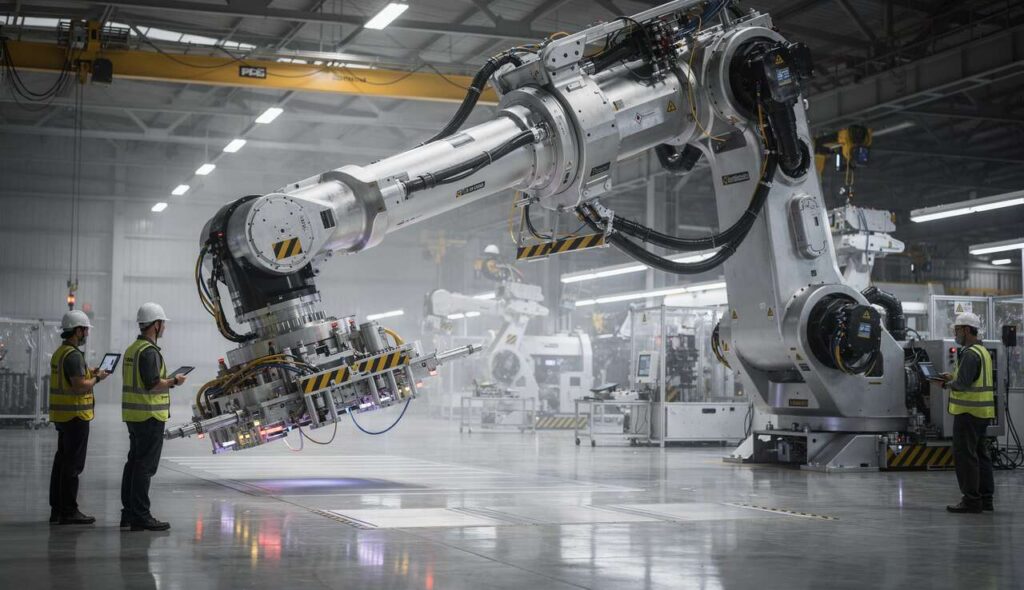
Industrial robotics has reached unprecedented heights of engineering excellence, with machines now capable of manipulating massive loads whilst maintaining microscopic precision. Among these technological marvels stands a revolutionary system that can lift 60 tonnes with an accuracy of 0.01 millimetres, challenging conventional understanding of mechanical limitations. This extraordinary achievement represents a convergence of advanced materials science, sophisticated control systems, and innovative design principles that redefine what automated machinery can accomplish in demanding industrial environments.
Presentation of the phenomenal robot
Technical specifications and core capabilities
This ultra-precise heavy-lifting robot combines exceptional load capacity with nanometre-level positioning accuracy, a feat previously considered mutually exclusive in mechanical engineering. The system integrates multiple actuators, advanced sensors, and real-time computational algorithms to achieve its remarkable performance envelope. Its operational parameters include:
- Maximum payload capacity of 60,000 kilogrammes
- Positioning accuracy of 0.01 millimetres across all axes
- Repeatability tolerance within 0.005 millimetres
- Operating speed adjustable from 0.1 to 500 millimetres per second
- Environmental compensation for temperature variations and vibrations
Physical architecture and construction
The robot’s structural framework employs composite materials specifically engineered to minimise thermal expansion whilst maximising rigidity. Carbon fibre-reinforced polymers work alongside precision-machined steel components to create a platform that remains dimensionally stable under extreme loads. The base structure alone weighs approximately 25 tonnes, providing the necessary inertial mass to counteract dynamic forces during operation.
Understanding these fundamental characteristics provides essential context for examining the complex engineering challenges that engineers overcame during development.
The associated technological challenges
Balancing load capacity with precision
The primary engineering paradox involved creating a system robust enough to handle massive loads whilst maintaining microscopic accuracy. Traditional heavy-lifting equipment sacrifices precision for strength, whilst ultra-precise positioning systems typically handle minimal weights. Bridging this gap required innovative solutions across multiple engineering domains.
| Challenge area | Traditional limitation | Innovative solution |
|---|---|---|
| Structural deflection | 5-10 mm under load | Active compensation reducing deflection to 0.005 mm |
| Thermal expansion | 0.5 mm per 10°C | Real-time correction maintaining 0.01 mm accuracy |
| Vibration damping | Resonance at operational speeds | Adaptive damping eliminating oscillations |
Sensor integration and data processing
Achieving the required precision demanded unprecedented sensor density and computational power. The system incorporates over 200 individual sensors monitoring position, force, temperature, and acceleration parameters simultaneously. Processing this data stream requires dedicated computing hardware capable of executing control algorithms at kilohertz frequencies, adjusting actuator commands thousands of times per second to maintain positioning accuracy.
These technical hurdles, once overcome, enabled the development of sophisticated operational mechanisms that distinguish this system from conventional industrial robots.
Operation and precise mechanisms
Multi-axis control systems
The robot employs a hierarchical control architecture with three distinct layers managing different aspects of motion. The primary layer handles gross positioning, moving the payload to approximate locations. The secondary layer refines position using feedback from laser interferometers, whilst the tertiary layer makes continuous micro-adjustments based on real-time sensor data to maintain the specified 0.01-millimetre tolerance.
Force sensing and load distribution
Integrated throughout the structure, piezoelectric force sensors detect minute variations in load distribution. This information feeds into predictive algorithms that anticipate structural deflection before it occurs, commanding compensatory movements to counteract deformation. The system can detect force changes as small as 10 newtons within a total load exceeding 600,000 newtons.
- Real-time structural analysis using finite element models
- Predictive compensation for dynamic loading conditions
- Adaptive grip force adjustment preventing load slippage
- Continuous calibration routines maintaining accuracy over time
Environmental compensation technologies
Temperature fluctuations pose significant challenges to precision machinery. This system incorporates active thermal management, using embedded heating and cooling elements to maintain critical components within a 0.5-degree Celsius temperature range. Additionally, accelerometers detect ambient vibrations from nearby machinery or seismic activity, triggering compensatory movements that isolate the payload from external disturbances.
These sophisticated operational capabilities enable deployment across diverse industrial sectors where both strength and precision prove essential.
Examples of industrial applications
Aerospace manufacturing and assembly
Aircraft construction demands precise positioning of massive components such as fuselage sections and wing assemblies. Traditional methods required extensive manual adjustment and measurement, consuming significant time and introducing potential errors. This robotic system positions components weighing up to 60 tonnes with alignment accuracies that eliminate subsequent adjustment phases, reducing assembly time by approximately 40 per cent whilst improving structural integrity.
Shipbuilding and marine engineering
Naval construction involves manipulating enormous steel sections that must align within millimetre tolerances to ensure proper welding and structural performance. The robot’s capabilities prove particularly valuable when:
- Positioning hull sections during modular assembly
- Installing propulsion systems requiring precise shaft alignment
- Mounting heavy deck equipment with exact positional requirements
- Handling bulkhead sections during compartment construction
Heavy equipment manufacturing
Producers of mining machinery, power generation equipment, and industrial presses utilise this technology for assembly operations where component masses exceed conventional handling capabilities. Turbine rotor installation, for instance, requires positioning multi-tonne components with bearing surface alignments measured in hundredths of millimetres to ensure proper operation and longevity.
The deployment of such advanced robotic systems across these industries generates profound effects on engineering practices and manufacturing methodologies.
Impacts on modern engineering
Manufacturing efficiency improvements
Implementation of ultra-precise heavy-lifting robots delivers measurable productivity gains across multiple metrics. Assembly cycle times decrease by 30 to 50 per cent compared to conventional methods, whilst quality metrics improve through elimination of human positioning errors. Manufacturers report reduced rework rates and fewer assembly-related defects, translating to substantial cost savings and improved product reliability.
Workforce evolution and skill requirements
The technology necessitates new competencies within industrial workforces. Operators require training in robotic programming, sensor diagnostics, and system maintenance rather than traditional rigging and manual positioning skills. This shift creates opportunities for higher-skilled employment whilst reducing physical demands and safety risks associated with heavy lifting operations.
| Traditional approach | Robotic system approach |
|---|---|
| Manual positioning with cranes | Automated precision placement |
| Multiple adjustment cycles | Single-pass accuracy |
| High physical risk to workers | Remote operation from safe locations |
| Limited repeatability | Consistent sub-millimetre repeatability |
Design philosophy transformations
Availability of such precise handling capabilities influences product design decisions. Engineers now specify tighter tolerances and more complex assemblies, knowing that manufacturing processes can reliably achieve these requirements. This enables optimised designs with reduced material usage, improved performance characteristics, and enhanced reliability through better component integration.
These present-day impacts provide foundation for considering how continued development of ultra-precise robotics will shape future industrial landscapes.
Future perspective of ultra-precise robots
Emerging technological enhancements
Research initiatives currently explore artificial intelligence integration that would enable robots to learn optimal handling strategies for different load types and geometries. Machine learning algorithms could analyse thousands of lift cycles, identifying patterns that improve efficiency and further enhance precision. Additionally, developments in quantum sensing technology promise positioning accuracies approaching atomic scales, potentially enabling precision measured in nanometres rather than hundredths of millimetres.
Expanded application domains
Future deployments may extend beyond traditional manufacturing into sectors such as:
- Construction of mega-structures including bridges and offshore platforms
- Installation of scientific instruments requiring extreme positioning accuracy
- Space industry applications for satellite and spacecraft assembly
- Nuclear facility maintenance where precision and remote operation prove critical
- Archaeological preservation involving precise movement of fragile artefacts
Integration with autonomous systems
The trajectory points towards fully autonomous manufacturing environments where ultra-precise robots coordinate with other automated systems without human intervention. Advanced planning algorithms would optimise production sequences, whilst robots communicate directly to coordinate complex multi-unit operations. Such integration could revolutionise industries requiring both massive scale and microscopic precision, fundamentally altering how humanity constructs large, complex systems.
The convergence of extreme load capacity with nanometre-level precision represents a paradigm shift in industrial robotics, demonstrating that apparent physical limitations can be overcome through innovative engineering. This technology delivers immediate practical benefits across aerospace, shipbuilding, and heavy manufacturing sectors whilst simultaneously enabling new design possibilities and manufacturing methodologies. As artificial intelligence, advanced materials, and quantum sensing technologies mature, future generations of ultra-precise robots will likely achieve capabilities that currently seem impossible, continuing to expand the boundaries of what automated systems can accomplish in service of human endeavour.