


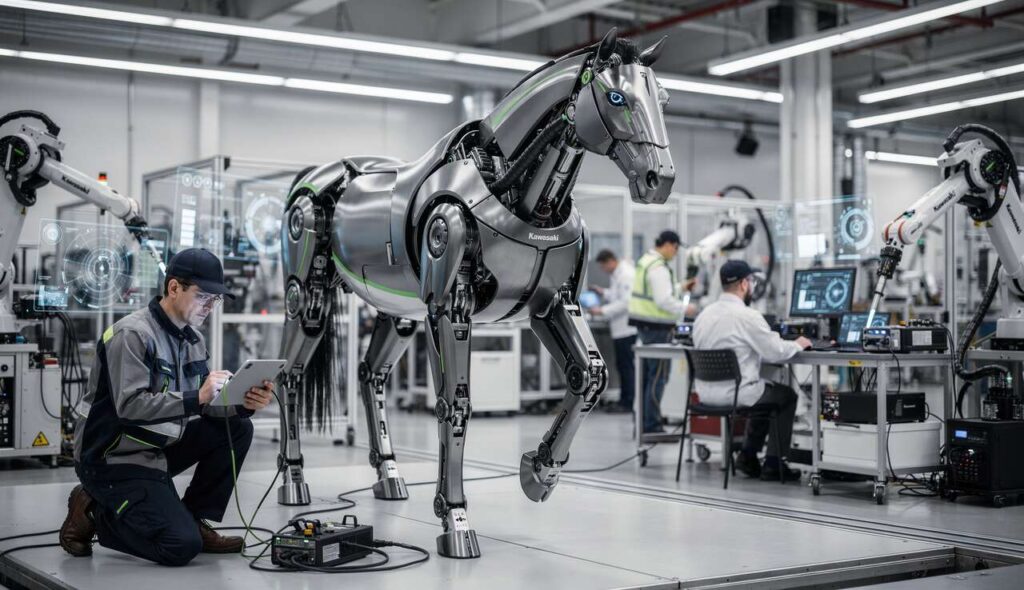
Kawasaki Heavy Industries has announced that its innovative robotic horse, initially unveiled as a concept, will now enter commercial production. This four-legged mechanical marvel represents a significant leap in the field of quadrupedal robotics, combining the company’s decades of engineering expertise with cutting-edge artificial intelligence and mobility systems. The decision to commercialise the robot horse signals growing confidence in the practical applications of such technology across multiple sectors, from agriculture to entertainment and beyond.
Introduction du cheval robotique de Kawasaki
Origins and development timeline
The Kawasaki robot horse project emerged from the company’s broader robotics division, which has long focused on industrial automation and advanced mechanical systems. The initial prototype was developed as an experimental platform to explore biomimetic locomotion and dynamic balance control. Engineers drew inspiration from actual equine movement patterns, studying how horses navigate diverse terrain with remarkable stability and efficiency.
The robot stands approximately one metre tall and weighs around 60 kilograms, making it substantially lighter than a real horse whilst maintaining impressive load-carrying capacity. Its design incorporates:
- Advanced servo motors in each joint for precise movement control
- Sophisticated sensor arrays for environmental awareness
- Rechargeable battery systems providing several hours of operation
- Weather-resistant housing suitable for outdoor deployment
- Modular construction allowing for customisation and repairs
Key design features
The mechanical horse features a distinctive skeletal framework that prioritises functionality over aesthetic realism. Rather than attempting to replicate a horse’s appearance exactly, Kawasaki’s engineers opted for an exposed mechanical design that showcases the sophisticated technology within. This approach not only reduces manufacturing costs but also facilitates maintenance and component replacement.
| Specification | Value |
|---|---|
| Height | 1.0 metres |
| Weight | 60 kg |
| Maximum speed | 10 km/h |
| Payload capacity | 100 kg |
| Battery life | 3-4 hours |
Understanding the technical specifications provides context for appreciating the sophisticated engineering that makes such mobility possible.
Technologie et innovation derrière le développement
Locomotion systems and balance control
The robot horse employs advanced gait algorithms that enable it to walk, trot, and navigate obstacles with remarkable fluidity. Each leg contains multiple degrees of freedom, allowing for adaptive stepping patterns that respond to terrain variations in real time. Pressure sensors in the feet provide continuous feedback about ground contact, enabling the system to adjust its balance dynamically.
Kawasaki’s proprietary control software processes data from numerous sensors simultaneously, making split-second adjustments to maintain stability even on uneven surfaces. This technology builds upon decades of research in bipedal and quadrupedal robotics, incorporating lessons learned from both industrial applications and academic research.
Artificial intelligence integration
The robot incorporates machine learning capabilities that allow it to improve performance over time. Through repeated operation, the system learns optimal movement patterns for different environments and tasks. The AI component also enables:
- Autonomous navigation using visual and spatial mapping
- Obstacle detection and avoidance without human intervention
- Task learning through demonstration and repetition
- Adaptive behaviour based on environmental conditions
- Remote operation and monitoring capabilities
These technological innovations position the robot horse as more than a simple remote-controlled device, transforming it into an intelligent mobile platform capable of semi-autonomous operation. Such capabilities naturally lead to questions about where and how this technology might be deployed.
Applications potentielles et impact sur l’industrie
Agricultural and rural applications
One of the most promising sectors for the robot horse is agriculture, where it could serve multiple functions. Farmers might deploy these machines for crop monitoring, transporting equipment across fields, or accessing areas where traditional vehicles struggle. The robot’s relatively low ground pressure reduces soil compaction compared to wheeled vehicles, potentially offering environmental benefits.
Entertainment and tourism
Theme parks and tourist attractions represent another significant market opportunity. The robot horse could provide unique interactive experiences without the complexities of managing live animals. This application appeals particularly to venues seeking innovative attractions that combine technology with traditional concepts.
Industrial and logistics sectors
Manufacturing facilities and warehouses might utilise robot horses for material transport in environments where wheeled robots face limitations. Their ability to navigate stairs, narrow passages, and irregular surfaces makes them valuable for certain logistics applications. Construction sites could similarly benefit from their all-terrain capabilities.
| Sector | Primary application | Key advantage |
|---|---|---|
| Agriculture | Field monitoring | Low soil impact |
| Entertainment | Interactive exhibits | Novel experience |
| Logistics | Material transport | Terrain flexibility |
| Research | Platform testing | Modular design |
As industries begin exploring these applications, market observers and potential customers are forming opinions about the technology’s viability.
Réactions et perspectives du marché
Industry expert opinions
Robotics specialists have expressed cautious optimism about Kawasaki’s commercialisation plans. Many note that whilst the technology demonstrates impressive capabilities, real-world adoption will depend heavily on pricing and practical reliability. Some experts question whether the robot horse offers sufficient advantages over existing wheeled or tracked robots to justify potential cost premiums.
Competitive landscape
Kawasaki enters a market where companies like Boston Dynamics have already established quadrupedal robot platforms. However, Kawasaki’s approach differs in emphasising industrial practicality over pure performance metrics. The company’s established relationships with manufacturing and industrial clients could provide distribution advantages.
Anticipated pricing and availability
Whilst Kawasaki has not disclosed specific pricing, industry analysts estimate the robot horse might retail between £50,000 and £80,000 depending on configuration. Initial production volumes are expected to be limited, with broader availability developing over subsequent years as manufacturing scales up. This measured approach to market entry reflects broader strategic thinking about the company’s robotics ambitions.
Vision future de Kawasaki pour la robotique
Expansion plans and product development
The robot horse represents just one element of Kawasaki’s comprehensive robotics strategy. Company representatives have indicated plans to develop a family of mobile robots addressing different applications and price points. Future iterations might incorporate enhanced autonomy, greater payload capacity, or specialised configurations for specific industries.
Research and collaboration initiatives
Kawasaki continues investing in fundamental robotics research, partnering with universities and research institutions to advance core technologies. These collaborations focus on areas including:
- Advanced materials for lighter, stronger components
- Improved battery technology for extended operation
- Enhanced AI algorithms for better decision-making
- Human-robot interaction and safety systems
- Environmental sensing and mapping capabilities
Such forward-looking initiatives inevitably raise questions about the broader implications of increasingly capable robotic systems.
Considérations éthiques et implications sociales
Employment and workforce considerations
As with many automation technologies, the robot horse raises questions about potential job displacement. Whilst proponents argue these machines handle tasks humans find difficult or dangerous, critics worry about employment impacts in sectors like agriculture where labour opportunities are already limited. Balanced discussion requires acknowledging both efficiency gains and social costs.
Animal welfare perspectives
Some animal welfare advocates view robotic alternatives as potentially beneficial, reducing reliance on working animals in demanding roles. However, others caution against viewing technology as a simple replacement for the complex relationships between humans and animals that have developed over millennia.
Environmental impact assessment
The environmental footprint of robot horses involves multiple considerations. Manufacturing requires significant resources and energy, whilst operation depends on electricity generation methods. However, potential benefits include reduced soil compaction in agriculture and elimination of methane emissions associated with livestock. Comprehensive lifecycle assessments will be necessary to evaluate net environmental impacts accurately.
Kawasaki’s robot horse represents a significant technological achievement with potential applications across numerous sectors. The transition from concept to commercial production demonstrates confidence in both the technology and market demand. Whilst questions remain about pricing, practical reliability, and broader societal implications, the project exemplifies how established industrial companies are expanding into advanced robotics. Success will ultimately depend on whether the robot horse delivers sufficient practical value to justify its costs, and whether society embraces this new category of working machines. The coming years will reveal whether this mechanical equine becomes a common sight in fields and facilities, or remains a fascinating but niche technological curiosity.