



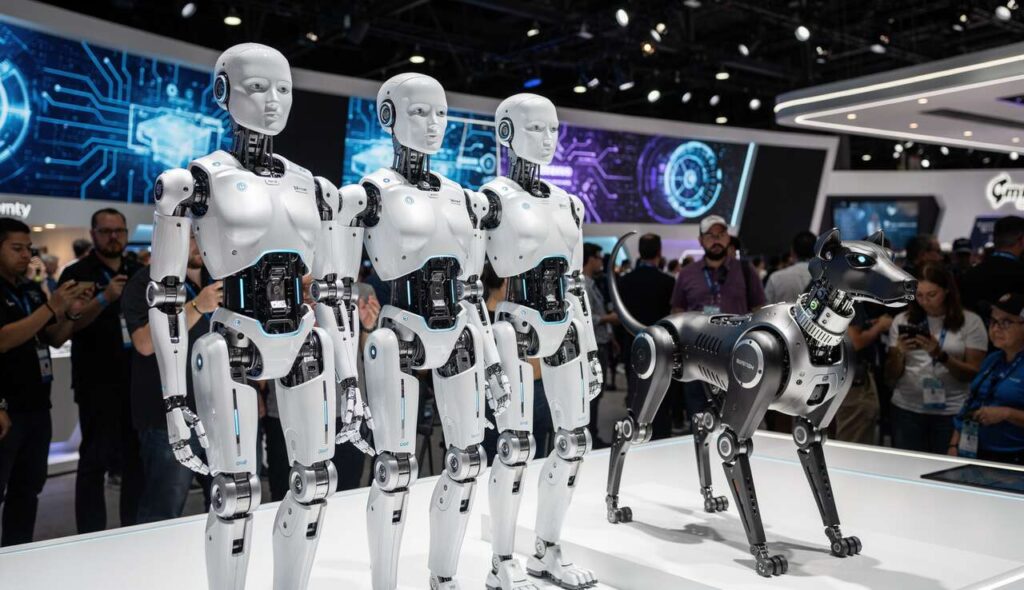
A Chinese robotics manufacturer has made waves across the Atlantic by unveiling an ambitious portfolio of advanced automation technology on American soil. The company’s presentation featured three distinct humanoid models alongside a quadrupedal robot dog, marking a significant moment in the ongoing technological competition between East and West. This deployment represents more than mere product demonstration; it signals China’s determination to establish itself as a formidable player in the rapidly expanding robotics sector. The timing of this launch coincides with heightened global interest in automation solutions across industries ranging from manufacturing to healthcare, positioning these machines at the intersection of commercial opportunity and strategic positioning.
Introduction to China’s automation army
The Chinese firm behind this technological showcase has assembled what industry observers are describing as an automation army, comprising multiple robotic platforms designed for diverse applications. The three humanoid robots each serve distinct purposes, whilst the robot dog model adds versatility to the portfolio. This multi-pronged approach demonstrates a sophisticated understanding of market segmentation and the varied demands of potential customers.
The strategic composition of the robotic fleet
The company’s decision to present four different models simultaneously reflects careful strategic planning. Rather than focusing resources on a single flagship product, the manufacturer has opted for a diversified portfolio strategy that addresses multiple market segments concurrently. This approach offers several advantages:
- Reduced dependency on any single product’s success or failure
- Ability to capture different customer segments with specific needs
- Demonstration of comprehensive technological capabilities across platforms
- Enhanced bargaining position when negotiating partnerships or contracts
Corporate background and manufacturing credentials
The firm responsible for this technological deployment has established itself within China’s rapidly growing robotics ecosystem over recent years. With substantial backing from both private investors and government initiatives supporting advanced manufacturing, the company has scaled operations considerably. Its production facilities employ cutting-edge manufacturing techniques including automated assembly lines that ironically use robots to build robots, creating a self-reinforcing cycle of technological advancement.
This foundation in automation expertise naturally leads to questions about how these machines will perform in the competitive American marketplace and what reception they might receive from potential customers.
Impact of humanoids on the US market
The introduction of three humanoid models to the United States market carries significant implications for domestic robotics companies and end-users alike. American firms have dominated certain segments of the automation industry, but Chinese manufacturers are increasingly challenging this supremacy with competitively priced alternatives that often match or exceed existing capabilities.
Market disruption potential
The arrival of these humanoid robots threatens to disrupt established pricing structures and performance expectations. Chinese manufacturers have historically leveraged lower production costs to offer attractive pricing whilst maintaining acceptable quality standards. This strategy has proven successful in numerous technology sectors, and robotics appears poised to follow a similar trajectory. The three humanoid models target different price points and capability levels:
| Model designation | Target application | Expected price range |
|---|---|---|
| Entry-level humanoid | Basic warehouse tasks | £30,000-£50,000 |
| Mid-range humanoid | Customer service roles | £60,000-£90,000 |
| Advanced humanoid | Complex manufacturing | £100,000-£150,000 |
Industry sector implications
Different American industries stand to experience varying degrees of impact from these new entrants. The logistics sector has already shown considerable interest in humanoid automation for warehouse operations, where repetitive tasks and labour shortages create ideal conditions for robotic deployment. Meanwhile, the hospitality industry views humanoid robots as potential solutions for front-desk operations and guest services, particularly in locations experiencing chronic staffing difficulties.
Manufacturing facilities represent another prime target market, with humanoids capable of performing assembly tasks, quality inspections, and material handling operations. The healthcare sector, though more cautious due to regulatory requirements, is monitoring developments closely for potential applications in patient transport and basic care assistance.
Understanding the practical capabilities that enable these diverse applications requires examining the technological foundations upon which these machines are built.
Technology behind humanoid robots
The engineering achievements embedded within these humanoid platforms reflect years of research and development across multiple disciplines. From advanced sensors to sophisticated control algorithms, these machines incorporate state-of-the-art components that enable human-like movement and interaction capabilities.
Sensor systems and environmental awareness
Modern humanoid robots rely on extensive sensor arrays to navigate environments and interact safely with humans. The Chinese models feature multiple camera systems providing 360-degree visual coverage, complemented by LIDAR sensors for precise distance measurements and spatial mapping. Tactile sensors embedded in the robotic hands enable delicate object manipulation, whilst force sensors throughout the body prevent excessive pressure that could damage objects or injure humans.
- High-resolution cameras for visual processing and facial recognition
- LIDAR arrays for three-dimensional environmental mapping
- Inertial measurement units for balance and orientation tracking
- Pressure-sensitive surfaces for safe physical interaction
- Microphone arrays for voice recognition and sound localisation
Artificial intelligence and control systems
The computational architecture powering these humanoids represents a significant achievement in applied artificial intelligence. Machine learning algorithms enable the robots to improve performance through experience, adapting to specific environments and tasks over time. Natural language processing capabilities allow verbal communication with human operators, whilst computer vision systems interpret visual information to identify objects, navigate obstacles, and recognise individuals.
The control systems managing movement represent particularly impressive engineering, as bipedal locomotion presents substantial challenges. Maintaining balance whilst walking, climbing stairs, or manipulating objects requires constant real-time adjustments coordinating dozens of motors and actuators. The Chinese firm has reportedly achieved walking speeds approaching human pace whilst maintaining stability across varied terrain types.
Whilst humanoid robots capture public imagination, the accompanying quadrupedal platform offers distinct advantages for certain applications.
The robot dog model: a technological innovation
The four-legged robot accompanying the humanoid trio draws inspiration from biological quadrupeds whilst incorporating thoroughly modern engineering solutions. This design philosophy yields a machine capable of traversing challenging terrain that would prove problematic for wheeled vehicles or bipedal robots.
Mechanical design and mobility capabilities
The robot dog features a articulated skeletal structure with independently controlled legs, each containing multiple joints that replicate the functionality of natural limbs. This configuration provides exceptional stability and manoeuvrability across uneven surfaces, stairs, and obstacles. The machine can adjust its gait dynamically, transitioning between walking, trotting, and running speeds as circumstances require.
Payload capacity represents a key specification, with the model capable of carrying equipment weighing up to 20 kilograms whilst maintaining full mobility. This capability opens applications in:
- Industrial inspection of hazardous or difficult-to-access areas
- Security patrol operations in large facilities or outdoor spaces
- Emergency response scenarios requiring equipment delivery
- Agricultural monitoring across uneven farmland terrain
- Construction site surveillance and progress documentation
Operational autonomy and remote control
The robot dog operates in multiple modes depending on task requirements. Fully autonomous operation relies on pre-programmed patrol routes and obstacle avoidance algorithms, allowing the machine to complete missions without human intervention. Semi-autonomous mode enables an operator to designate waypoints whilst the robot handles navigation details independently. Direct remote control provides precise operator command when situations demand human judgement.
Battery technology limits operational duration to approximately four hours of continuous activity, though this varies based on terrain difficulty and payload weight. The machine returns automatically to charging stations when power reserves reach predetermined thresholds, ensuring uninterrupted operational coverage through coordinated deployment of multiple units.
These technological capabilities carry implications extending beyond commercial considerations into broader economic and political dimensions.
Economic and geopolitical repercussions
The deployment of Chinese robotics technology in the United States occurs against a backdrop of ongoing technological competition and trade tensions between the world’s two largest economies. This context transforms what might otherwise be straightforward commercial activity into an event laden with strategic significance.
Trade dynamics and market access
Chinese technology companies face scrutiny when entering American markets, particularly in sectors deemed sensitive to national security interests. Robotics platforms equipped with cameras, sensors, and network connectivity raise concerns about data collection and potential surveillance capabilities. The manufacturer must navigate regulatory requirements whilst addressing customer apprehensions about technology originating from a geopolitical competitor.
Conversely, successful market penetration could establish precedents benefiting other Chinese technology firms seeking American customers. Demonstrating that Chinese robotics can meet stringent safety standards, perform reliably, and integrate smoothly with existing systems would counter negative perceptions and open doors for follow-on products.
Employment and workforce implications
The introduction of capable humanoid robots inevitably raises questions about workforce displacement and employment impacts. Industries considering robotic adoption must weigh productivity gains against potential job losses and the social costs associated with unemployment. The debate encompasses multiple perspectives:
| Stakeholder group | Primary concern | Potential benefit |
|---|---|---|
| Workers | Job displacement | Elimination of dangerous tasks |
| Employers | Implementation costs | Increased productivity |
| Policymakers | Social stability | Economic competitiveness |
| Consumers | Service quality | Lower prices |
These complex dynamics will shape how the robotics industry evolves and what role Chinese manufacturers ultimately play in that development.
Future perspectives for Chinese automation
The current product launch represents merely an opening move in what promises to be an extended campaign by Chinese robotics firms to establish global market presence. Industry analysts anticipate continued technological advancement and increasingly sophisticated offerings as companies refine their products based on customer feedback and operational experience.
Technological development trajectories
Future iterations of these robotic platforms will likely incorporate enhanced artificial intelligence capabilities, improved battery technology extending operational duration, and more sophisticated sensors enabling finer environmental perception. The integration of 5G connectivity will facilitate real-time data transmission and remote monitoring, whilst edge computing capabilities will enable more processing to occur onboard the robots themselves rather than relying on cloud infrastructure.
Collaborative capabilities represent another development frontier, with robots increasingly able to work alongside humans and coordinate with other machines to accomplish complex tasks requiring multiple actors. This evolution from isolated tools to integrated team members will expand the range of applications where robotic deployment makes economic and practical sense.
The competitive landscape will intensify as both Chinese and Western manufacturers race to capture market share in this rapidly expanding sector, driving innovation whilst potentially triggering price competition that benefits customers but pressures profit margins.
The emergence of Chinese robotics manufacturers as serious competitors in Western markets marks a pivotal moment in the automation industry’s evolution. The deployment of three humanoid robots and a quadrupedal platform in the United States demonstrates technological capabilities that match or exceed existing offerings whilst potentially undercutting established pricing structures. These machines incorporate sophisticated sensors, advanced artificial intelligence, and impressive mechanical engineering that enable diverse applications across multiple industries. The economic implications extend beyond simple commercial transactions into questions of workforce displacement, industrial competitiveness, and technological sovereignty. Geopolitical dimensions add further complexity as nations balance the benefits of advanced automation against concerns about dependence on foreign technology providers. As Chinese firms continue refining their products and expanding market presence, the robotics landscape will likely experience significant disruption, ultimately benefiting end-users through improved capabilities and competitive pricing whilst challenging incumbent manufacturers to innovate or risk obsolescence.