


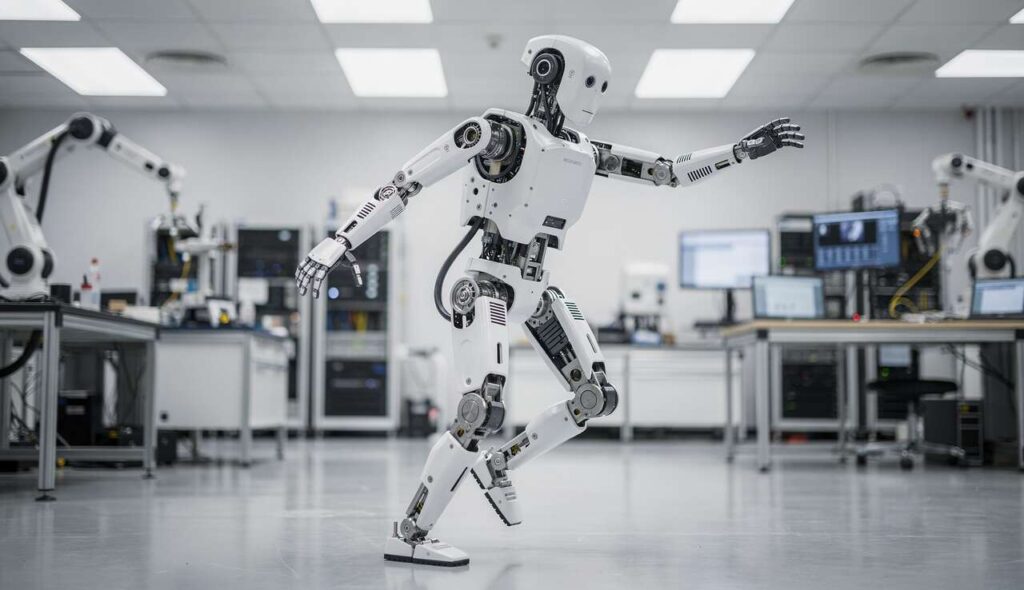
Boston Dynamics has once again pushed the boundaries of robotics with a demonstration that leaves audiences both mesmerised and unsettled. The latest footage showcasing their humanoid and quadruped machines performing tasks with uncanny fluidity has sparked widespread discussion about the rapid advancement of robotic technology. These machines move with such precision and human-like grace that they challenge our perceptions of what artificial systems can achieve. The demonstration reveals capabilities that seemed confined to science fiction merely a decade ago, yet now stand before us as tangible reality.
A brand-new Boston Dynamics demo
What the demonstration reveals
The recent Boston Dynamics demonstration features Atlas, the company’s flagship humanoid robot, performing a series of complex manoeuvres that showcase remarkable dexterity and balance. The video displays Atlas navigating obstacle courses, manipulating objects with surprising delicacy, and recovering from deliberate disruptions with almost biological reflexes. Spot, the quadruped robot, appears alongside Atlas, demonstrating coordinated teamwork that suggests sophisticated inter-robot communication protocols.
Key highlights from the demonstration include:
- Atlas executing parkour-style movements including backflips and precision jumps
- Seamless object manipulation using gripper hands designed for industrial applications
- Dynamic balance recovery after being pushed or encountering unexpected obstacles
- Spot navigating complex terrain whilst carrying payloads
- Synchronised movements between multiple robots operating in shared spaces
The visceral response from viewers
The demonstration provokes an instinctive reaction that many describe as unsettling. This response stems from the uncanny valley phenomenon, where robots that closely mimic biological movement trigger discomfort rather than familiarity. The fluidity of Atlas’s movements, particularly when recovering balance or adjusting grip, mirrors human behaviour so closely that it creates a cognitive dissonance. Viewers report experiencing genuine surprise at the robots’ capabilities, with some admitting to feeling goose bumps as they watch machines perform tasks previously considered uniquely human.
These visceral reactions point to deeper questions about how society perceives and relates to increasingly sophisticated machines, setting the stage for understanding the technology that makes such demonstrations possible.
The groundbreaking technology of the robots
Advanced hydraulic and electric systems
Boston Dynamics employs cutting-edge hydraulic actuators in Atlas that provide the power-to-weight ratio necessary for explosive movements like jumping and flipping. These systems generate forces comparable to human muscles whilst maintaining precise control. The company has also developed proprietary electric motors for Spot that offer quieter operation and greater energy efficiency, making the quadruped suitable for extended missions in diverse environments.
| Component | Atlas specification | Spot specification |
|---|---|---|
| Height | 1.5 metres | 0.84 metres |
| Weight | 89 kilograms | 32.5 kilograms |
| Power system | Hydraulic | Electric |
| Battery duration | Approximately 1 hour | 90 minutes |
Sensor fusion and real-time processing
The robots integrate multiple sensor types to create comprehensive environmental awareness. LIDAR systems generate three-dimensional maps of surroundings, whilst stereo cameras provide depth perception and object recognition. Inertial measurement units track orientation and acceleration, enabling the split-second adjustments necessary for maintaining balance on unstable surfaces. This sensor data feeds into onboard computers that process information in real-time, making autonomous decisions about movement and interaction.
Boston Dynamics has developed proprietary algorithms that allow these machines to predict and compensate for disturbances, whether from external forces or terrain irregularities. The software architecture represents years of refinement, building upon lessons learned from each generation of robots.
Machine learning and adaptive behaviour
Modern Boston Dynamics robots incorporate machine learning techniques that enable them to improve performance through experience. Rather than relying solely on pre-programmed movements, the systems can adapt to novel situations by drawing upon learned patterns. This capability allows Atlas to adjust its gait when encountering different surfaces or modify grip strength based on object properties detected through tactile sensors.
Understanding these technological foundations provides context for appreciating how far Boston Dynamics has progressed since its inception.
Reflections on the evolution of Boston Dynamics robots
From BigDog to Spot
Boston Dynamics emerged from research conducted at the Massachusetts Institute of Technology, with early projects focusing on quadruped locomotion. BigDog, introduced in the mid-2000s, demonstrated remarkable stability on rough terrain but suffered from excessive noise due to its petrol engine. The evolution to Spot represents a quantum leap in practicality, with electric motors enabling quieter operation suitable for indoor environments and commercial applications. The refinement process involved countless iterations, each addressing specific limitations identified through rigorous testing.
The Atlas lineage
Atlas has undergone dramatic transformations since its initial versions, which were tethered to external power sources and required support structures. Early iterations moved with jerky, mechanical motions that bore little resemblance to biological movement. Successive generations achieved progressively greater autonomy, smoother motion, and enhanced capabilities. The current Atlas stands as the culmination of this development trajectory, incorporating lessons from failures and successes alike.
Key milestones in Atlas development include:
- Transition from tethered to battery-powered operation
- Achievement of dynamic balance without external support
- Development of manipulation capabilities through gripper integration
- Implementation of parkour movements demonstrating agility
- Miniaturisation of control systems for reduced weight
Lessons from competitive pressure
Boston Dynamics operates within an increasingly competitive landscape where companies and research institutions worldwide pursue similar goals. This competition has accelerated development cycles and pushed the boundaries of what robots can achieve. The company’s willingness to share demonstration videos, whilst maintaining proprietary control over core technologies, has created public awareness that drives both interest and investment in the field. This evolutionary journey raises important questions about the broader implications of such rapid technological progress.
The ethical implications of these technological advances
Military applications and autonomous weapons
Boston Dynamics has maintained a stated policy against weaponising its robots, yet the technology’s potential for military use remains a contentious issue. The same capabilities that enable Atlas to navigate disaster zones could theoretically be adapted for combat scenarios. Autonomous weapon systems represent a particularly troubling possibility, where machines make life-or-death decisions without human oversight. International bodies have called for regulations governing such applications, but enforcement mechanisms remain underdeveloped.
Labour displacement concerns
As robots become capable of performing tasks currently undertaken by human workers, legitimate concerns arise about employment disruption. Industries ranging from warehousing to construction could see significant automation, potentially displacing workers who lack opportunities for retraining. Proponents argue that robotics will create new job categories whilst eliminating dangerous or repetitive work, but the transition period may prove economically painful for affected communities.
Privacy and surveillance considerations
Mobile robots equipped with advanced sensors could enable unprecedented surveillance capabilities. Spot has already been deployed by law enforcement agencies, raising questions about appropriate use limitations and oversight. The potential for mission creep, where initially benign applications expand into invasive monitoring, requires careful regulatory frameworks that balance legitimate security needs against individual privacy rights.
These ethical considerations exist alongside the diverse reactions that Boston Dynamics demonstrations consistently provoke from the public.
Public reactions to these astonishing robots
Fascination and technological optimism
Many viewers respond to Boston Dynamics demonstrations with genuine excitement about technological progress. Engineers and technology enthusiasts celebrate the achievements as proof that ambitious goals can be realised through persistent innovation. This optimistic perspective envisions robots as tools that will enhance human capabilities, perform dangerous tasks, and unlock new possibilities in exploration and manufacturing.
Anxiety and dystopian fears
Conversely, significant portions of the audience express discomfort or outright fear when viewing the demonstrations. References to science fiction scenarios where robots pose existential threats to humanity appear frequently in comment sections and social media discussions. The uncanny movement of these machines triggers instinctive wariness, perhaps rooted in evolutionary psychology that identifies non-human entities mimicking human behaviour as potential threats.
Cultural interpretations and memes
Boston Dynamics demonstrations have spawned countless internet memes and cultural references, from humorous comparisons to fictional robots to darker commentary on technological overreach. This memetic response reflects how society processes and contextualises rapid technological change through familiar cultural frameworks. The reactions span the spectrum from playful to genuinely concerned, illustrating the complex emotions these machines evoke.
Understanding current public sentiment helps frame discussions about how these technologies might integrate into everyday existence.
The future of robots in our daily lives
Commercial and industrial applications
Boston Dynamics has already begun commercialising Spot for industrial inspection tasks, where the robot navigates facilities to monitor equipment, detect anomalies, and gather data. Future applications may include:
- Construction site monitoring and safety inspections
- Warehouse logistics and inventory management
- Agricultural monitoring of crops and livestock
- Infrastructure maintenance in hazardous environments
- Emergency response in disaster scenarios
Domestic integration possibilities
Whilst current Boston Dynamics robots remain too expensive and specialised for household use, future iterations could assist with domestic tasks. Elderly care represents a particularly promising application, where robots could help with mobility, medication reminders, and emergency response. The challenge lies in developing systems that are affordable, safe, and genuinely useful rather than novelties.
Regulatory frameworks and standards
As robots become more prevalent, societies will need comprehensive regulations addressing safety standards, liability questions, and appropriate use limitations. Who bears responsibility when a robot causes harm ? What certifications should operators require ? These questions demand thoughtful answers that balance innovation against legitimate safety concerns. International cooperation will prove essential, as robots operate across borders and regulatory fragmentation could hinder beneficial applications whilst failing to prevent harmful ones.
Boston Dynamics’ latest demonstration represents more than impressive engineering; it offers a glimpse into a future where sophisticated robots operate alongside humans in diverse contexts. The technology has progressed from laboratory curiosity to practical capability, with machines now performing tasks that seemed impossible mere years ago. Whilst the demonstrations provoke visceral reactions ranging from wonder to unease, they ultimately reflect humanity’s enduring drive to extend capabilities through technological innovation. The ethical challenges and societal implications require serious consideration, but the potential benefits in safety, efficiency, and exploration remain compelling. How society chooses to deploy and regulate these technologies will determine whether they fulfil their promise or validate the concerns they inspire.