



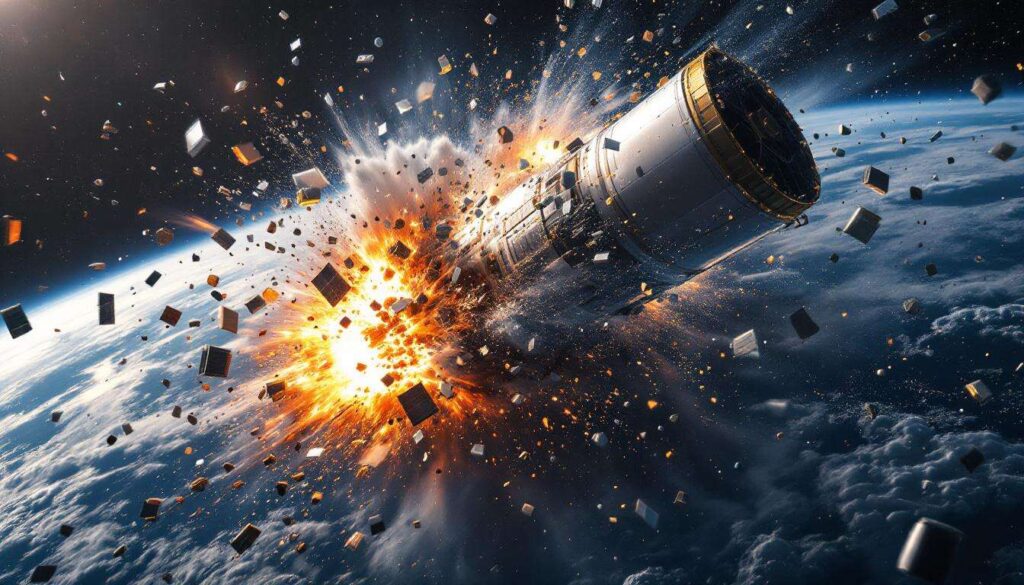
A Chinese satellite has reportedly disintegrated whilst travelling at supersonic speed through the Earth’s atmosphere, generating a powerful shockwave that has raised significant concerns within the international aerospace community. The incident, which occurred as the spacecraft re-entered the planet’s atmosphere in an uncontrolled manner, has sparked debate about the safety protocols surrounding satellite decommissioning and the growing challenge of space debris management. Eyewitness accounts and preliminary data suggest that the satellite broke apart violently, creating sonic booms audible across a wide geographical area. This event underscores the increasing risks associated with the expanding number of artificial objects orbiting our planet and highlights the urgent need for improved tracking systems and international cooperation in space operations.
Chinese satellite disintegration: the facts
Details of the re-entry event
The satellite in question was reportedly part of China’s extensive network of Earth observation and communications satellites. According to tracking data from multiple international space monitoring agencies, the spacecraft began its uncontrolled descent after completing its operational lifespan. The disintegration occurred at an altitude of approximately 70 to 80 kilometres, where atmospheric density increases sufficiently to generate extreme frictional heating on objects travelling at orbital velocities. The supersonic speed at which the satellite was travelling, estimated at several times the speed of sound, created a cascading failure as structural components succumbed to thermal and mechanical stress.
Observable phenomena during breakup
Witnesses across several regions reported seeing bright streaks of light in the sky, accompanied by loud sonic booms that rattled windows and alarmed residents. The shockwave produced by the disintegrating satellite was powerful enough to be detected by seismological equipment in neighbouring areas. Key characteristics of the event included:
- Multiple fragmentation events as the satellite broke into smaller pieces
- Visible plasma trails caused by superheated metal and composite materials
- Acoustic signatures consistent with supersonic compression waves
- Radar signatures indicating a debris field spanning several kilometres
Space agencies have confirmed that the majority of the satellite’s mass was consumed during atmospheric re-entry, though some hardened components may have survived to reach the surface. Understanding the precise sequence of events during the breakup provides crucial information for assessing the immediate and long-term implications of such incidents.
Environmental impact of the supersonic shock
Atmospheric disturbance and pollution
The disintegration of a satellite at supersonic speeds releases significant quantities of particulate matter and chemical compounds into the upper atmosphere. Modern satellites contain various materials including aluminium alloys, titanium, composite materials, and electronic components with trace amounts of heavy metals. When these materials burn up during re-entry, they create aerosols that can persist in the stratosphere for extended periods. The environmental consequences of such events include:
| Pollutant Type | Source | Atmospheric Impact |
|---|---|---|
| Aluminium oxide particles | Structural components | Potential ozone layer interaction |
| Heavy metals | Electronic circuits | Long-term atmospheric contamination |
| Composite fibres | Thermal shielding | Particulate pollution |
Sonic impact on terrestrial ecosystems
The powerful shockwave generated by the satellite’s supersonic disintegration can have measurable effects on wildlife and ecosystems below. Birds and other animals sensitive to sudden loud noises may experience stress responses, whilst the acoustic energy can potentially affect marine life if the event occurs over oceanic regions. Although such incidents are relatively rare, the cumulative impact of increasing satellite re-entries warrants careful monitoring and assessment by environmental scientists.
These environmental considerations naturally lead to questions about the broader safety implications for aviation and populated areas beneath satellite trajectories.
Potential dangers to airspace
Risks to commercial aviation
Uncontrolled satellite re-entries pose genuine hazards to commercial aircraft operating at high altitudes. Modern passenger jets routinely cruise at altitudes between 10 and 13 kilometres, placing them well below the typical disintegration altitude but potentially within range of larger debris fragments that may survive initial breakup. The aviation industry has expressed concern about:
- Inadequate warning systems for pilots regarding satellite re-entry events
- The difficulty of predicting precise re-entry trajectories and timings
- Potential for catastrophic collisions with high-velocity debris
- The need for coordinated airspace closures during high-risk periods
Ground-level hazards
Whilst the majority of satellite mass burns up during atmospheric re-entry, dense components such as fuel tanks, batteries, and structural reinforcements can survive to impact the Earth’s surface. The Chinese satellite incident has renewed focus on the statistical probability of debris striking populated areas. Historical data indicates that most surviving fragments fall into oceans or uninhabited regions, but the expanding global population and increasing frequency of satellite launches elevate the overall risk profile.
The safety concerns arising from this incident have prompted reflection on how such events might influence China’s ambitious space programme moving forwards.
Consequences on Chinese space development
Reputational and technical implications
The uncontrolled disintegration of a Chinese satellite represents a setback for the nation’s space programme, which has made remarkable strides in recent years. China has invested heavily in developing comprehensive space capabilities, including satellite constellations, lunar exploration missions, and the construction of its own space station. This incident may prompt internal reviews of satellite design standards, particularly regarding:
- End-of-life disposal protocols and controlled de-orbit capabilities
- Structural integrity requirements for atmospheric re-entry scenarios
- Enhanced tracking and monitoring systems for ageing satellites
- International transparency regarding satellite operations and trajectories
Impact on future missions
Chinese space authorities may implement more stringent safety measures for future satellite deployments, including mandatory propulsion systems for controlled de-orbiting. The incident serves as a reminder that responsible space operations require comprehensive planning not only for launch and operational phases but also for the eventual disposal of spacecraft. This philosophy aligns with emerging international norms regarding sustainable space activities.
The incident’s ramifications extend beyond China’s borders, prompting responses from the international community and discussions about regulatory frameworks.
International reactions and future regulations
Global response to the incident
Space agencies and governments worldwide have monitored the Chinese satellite disintegration with considerable interest. The United Nations Office for Outer Space Affairs has emphasised the importance of adhering to established guidelines for space debris mitigation. International reactions have included:
- Calls for improved transparency in satellite tracking and re-entry predictions
- Requests for post-incident reports detailing the cause of the uncontrolled re-entry
- Discussions about strengthening existing space debris mitigation guidelines
- Proposals for enhanced international cooperation in space traffic management
Regulatory developments and future standards
The incident has accelerated discussions about implementing binding international regulations for satellite operations and disposal. Current guidelines are largely voluntary, leading to inconsistent compliance across different space-faring nations. Proposed regulatory enhancements include mandatory controlled de-orbit capabilities for all satellites above a certain mass threshold, standardised reporting protocols for re-entry events, and potential liability frameworks for damages caused by space debris.
The disintegration of the Chinese satellite at supersonic speed has illuminated critical vulnerabilities in current space operations practices. From the environmental impact of atmospheric pollution to the tangible risks posed to aviation and ground-level populations, the incident demonstrates that the consequences of uncontrolled re-entries extend far beyond the immediate spectacle of a spacecraft’s fiery demise. For China, the event represents both a technical challenge and an opportunity to enhance safety protocols within its expanding space programme. Internationally, the incident has catalysed renewed momentum towards establishing comprehensive regulatory frameworks that balance the benefits of space exploration with the imperative of protecting Earth’s environment and populations. As humanity’s presence in space continues to grow, the lessons learned from such events will prove essential in ensuring that orbital activities remain sustainable and safe for generations to come.