

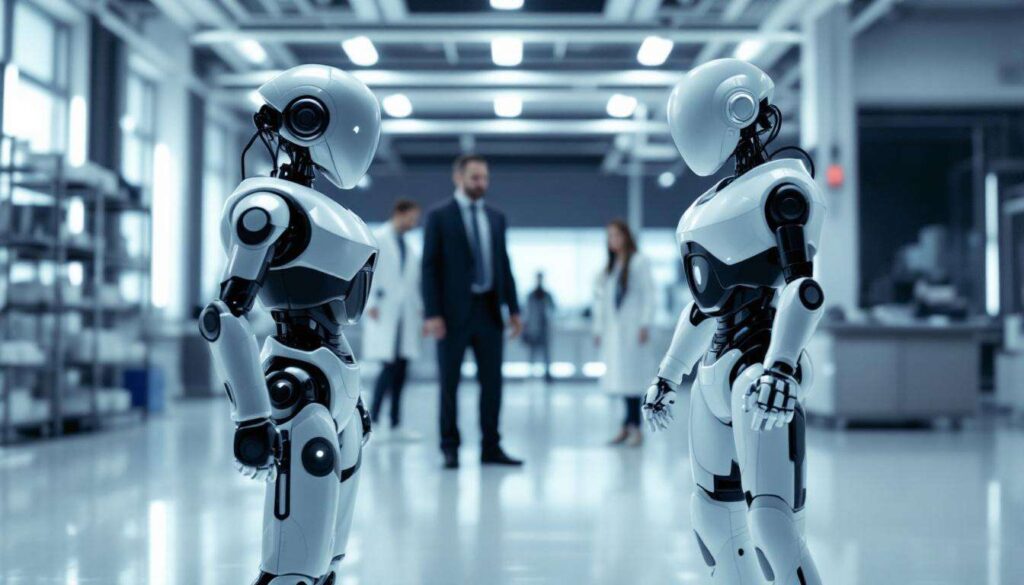
The race to develop advanced humanoid robots has intensified as two prominent companies, Boston Dynamics and Tesla, push the boundaries of robotics technology. Boston Dynamics’ Atlas represents years of research in dynamic movement and agility, whilst Tesla’s Optimus embodies a more recent entry focused on practical applications and mass production. Both machines demonstrate remarkable engineering achievements, yet they pursue distinctly different philosophies in design, functionality, and intended use cases. Understanding the contrasts between these robotic platforms reveals not only the current state of humanoid robotics but also the divergent paths this technology may follow in coming years.
Introduction to humanoid robots
Defining humanoid robotics
Humanoid robots are mechanical systems designed to resemble the human form, typically featuring a torso, head, two arms, and two legs. These machines aim to replicate human movements and interactions, making them suitable for environments originally designed for people. The fundamental appeal lies in their ability to navigate stairs, manipulate tools, and operate in spaces where wheeled or alternative robotic designs would struggle.
Historical development
The evolution of humanoid robotics spans several decades, with significant milestones including:
- Early prototypes in the 1970s that demonstrated basic bipedal walking
- Honda’s ASIMO in 2000, which showcased refined balance and mobility
- Boston Dynamics’ Atlas debut in 2013, revolutionising dynamic movement
- Tesla’s Optimus announcement in 2021, targeting commercial viability
These developments reflect an ongoing pursuit to create machines that can seamlessly integrate into human-centric environments. The technological progression has accelerated considerably, driven by advances in artificial intelligence, sensor technology, and actuator design. This foundation sets the stage for examining how Atlas and Optimus represent two distinct approaches to achieving humanoid functionality.
Design and technical characteristics
Atlas: research-focused engineering
Boston Dynamics’ Atlas stands approximately 1.5 metres tall and weighs around 89 kilograms. The robot features 28 hydraulic joints that provide exceptional power and range of motion. Its design prioritises dynamic stability and athletic performance, enabling movements such as backflips, parkour manoeuvres, and rapid directional changes. The hydraulic system delivers substantial force output, though it requires complex infrastructure including pumps, valves, and power supplies.
Optimus: production-oriented design
Tesla’s Optimus measures approximately 1.73 metres in height and weighs roughly 73 kilograms. The robot utilises electric actuators rather than hydraulics, which simplifies maintenance and reduces complexity. Tesla has designed Optimus with manufacturing scalability in mind, incorporating components and processes familiar from automotive production. The robot features over 40 electromechanical actuators and is built around a philosophy of cost-effectiveness and mass production potential.
Comparative specifications
| Characteristic | Atlas | Optimus |
|---|---|---|
| Height | 1.5 m | 1.73 m |
| Weight | 89 kg | 73 kg |
| Actuation | Hydraulic | Electric |
| Primary focus | Research and demonstration | Commercial deployment |
The contrasting technical approaches reflect fundamentally different objectives, with Atlas emphasising performance capabilities whilst Optimus targets practical deployment scenarios. These design philosophies naturally influence what each robot can accomplish in real-world settings.
Capabilities and performance
Atlas mobility and agility
Atlas demonstrates extraordinary dynamic capabilities that surpass most existing humanoid robots. The machine can execute complex movements including:
- Running across varied terrain at speeds exceeding walking pace
- Performing gymnastic routines with multiple aerial rotations
- Recovering balance after significant disturbances or impacts
- Navigating obstacle courses with jumps and precision landings
These capabilities stem from sophisticated real-time control algorithms that continuously adjust joint positions and forces. Atlas processes data from numerous sensors including gyroscopes, accelerometers, and position encoders to maintain stability during highly dynamic activities.
Optimus practical functionality
Optimus focuses on practical task execution rather than athletic performance. Tesla has demonstrated the robot performing activities such as sorting objects, watering plants, and basic manipulation tasks. The design emphasises repeatability and reliability in structured environments. Optimus integrates Tesla’s artificial intelligence technology, particularly neural networks developed for autonomous vehicle perception and decision-making.
Manipulation and dexterity
Both robots feature sophisticated hand designs, though with different emphases. Atlas employs grippers designed for robust grasping in challenging conditions, whilst Optimus hands contain tactile sensors and fine motor control suited for delicate manipulation. The distinction reflects their respective priorities: Atlas for research demonstrations and Optimus for repetitive industrial tasks.
Understanding these performance characteristics provides context for evaluating where each robot might find practical application in various industries and settings.
Real-world applications
Industrial and manufacturing contexts
Tesla envisions Optimus operating in factory environments, performing repetitive tasks that are currently dangerous or tedious for human workers. Potential applications include:
- Material handling and component transport within production facilities
- Assembly line operations requiring precise, repeated movements
- Quality inspection tasks using integrated vision systems
- Warehouse logistics and inventory management
The robot’s design specifically targets cost-effective deployment at scale, with Tesla aiming for production costs that would make widespread adoption economically feasible.
Research and development
Atlas primarily serves as a research platform advancing the understanding of dynamic locomotion and control. Boston Dynamics has explored applications in search and rescue scenarios, hazardous environment inspection, and military logistics support. However, the complexity and cost of Atlas limit its immediate commercial deployment, positioning it more as a technology demonstrator than a production-ready solution.
Service and assistance roles
Both companies have discussed potential applications in service industries and domestic assistance. Humanoid robots could theoretically perform tasks such as elderly care support, household maintenance, or customer service roles. However, significant technical and regulatory hurdles remain before such deployments become commonplace.
These application scenarios raise important questions about the trajectory of humanoid robotics and what developments might emerge in the near future.
Future prospects of humanoid robots
Technological advancement trajectories
The development paths for Atlas and Optimus suggest two complementary approaches to advancing humanoid robotics. Boston Dynamics continues pushing the boundaries of what is physically possible, creating capabilities that may eventually filter down to commercial products. Tesla focuses on immediate practical deployment, potentially accelerating market adoption even if current capabilities remain more modest.
Market potential and adoption barriers
Several factors will influence the widespread adoption of humanoid robots:
- Manufacturing costs must decrease substantially for mass deployment
- Reliability and maintenance requirements need improvement for continuous operation
- Artificial intelligence systems require further development for autonomous decision-making
- Regulatory frameworks must evolve to address safety and liability concerns
Tesla’s projected production cost of under £20,000 per unit represents a significant reduction compared to current research platforms, potentially enabling broader accessibility.
Integration challenges
Beyond technical specifications, successful deployment requires addressing human-robot interaction, workplace integration, and social acceptance. Organisations must redesign workflows, train personnel, and establish protocols for safe collaboration between humans and humanoid robots. These non-technical factors may ultimately prove more challenging than the engineering obstacles.
As these technologies mature, society must grapple with broader questions about their impact and appropriate governance.
Conclusion and ethical implications
Societal considerations
The advancement of humanoid robots raises important ethical questions regarding employment displacement, privacy, and autonomy. As machines become capable of performing tasks traditionally requiring human workers, societies must address potential job market disruptions and economic transitions. The presence of mobile, human-shaped robots in public and private spaces also creates surveillance and data collection concerns that require careful regulation.
Governance and safety
Establishing appropriate safety standards and regulatory frameworks remains crucial as humanoid robots transition from laboratories to real-world environments. Questions of liability, accountability, and decision-making authority need resolution before widespread deployment can proceed responsibly.
Atlas and Optimus represent divergent yet complementary approaches to humanoid robotics, with Boston Dynamics demonstrating technical possibilities whilst Tesla pursues commercial viability. The contrasts in their design philosophies, capabilities, and intended applications reflect broader questions about the future role of humanoid robots in society. As these technologies mature, the balance between performance, practicality, and ethical considerations will shape how humanoid robots integrate into daily life, potentially transforming industries whilst requiring thoughtful governance to ensure benefits are broadly distributed and risks appropriately managed.