



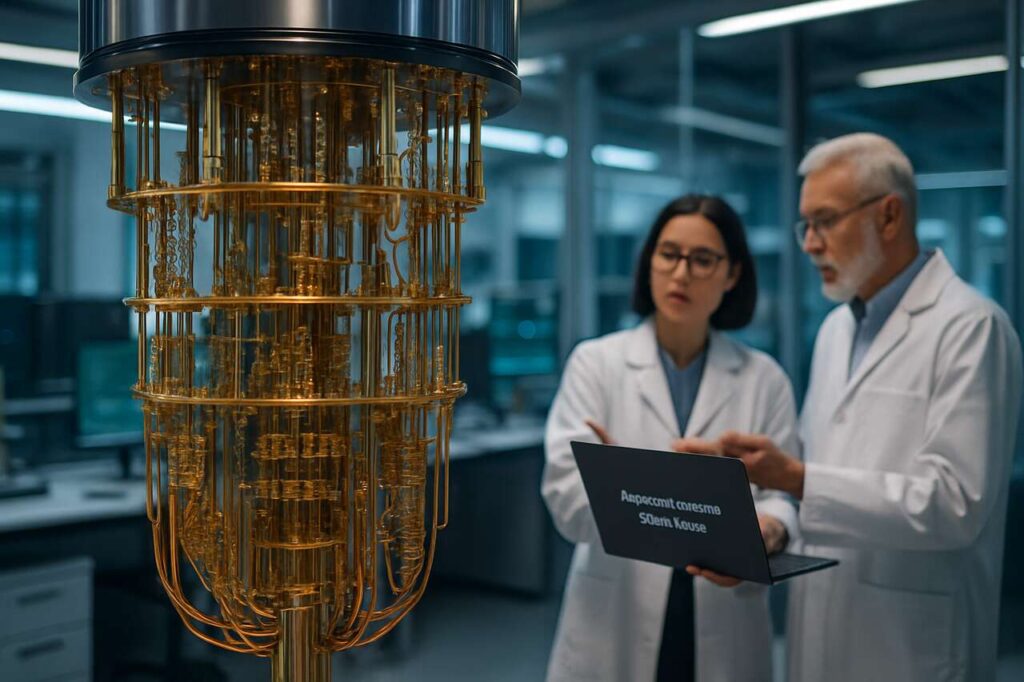
Quantum computing has long promised revolutionary advances across multiple sectors, yet practical implementation has remained frustratingly elusive. Recent developments in partial error correction techniques are now bridging the gap between theoretical potential and real-world application, particularly within machine learning frameworks. These innovations are reducing the astronomical hardware requirements that have historically constrained quantum systems, bringing commercially viable quantum machine learning closer to reality than ever before.
Introduction to quantum machine learning
Defining quantum machine learning
Quantum machine learning represents the convergence of quantum computing principles with classical machine learning algorithms. This interdisciplinary field exploits quantum mechanical phenomena such as superposition and entanglement to process information in fundamentally different ways compared to conventional computers. Rather than manipulating bits that exist as either zero or one, quantum systems utilise qubits that can exist in multiple states simultaneously, enabling parallel processing at scales unattainable through traditional methods.
The theoretical advantages are substantial:
- Exponential speedup for specific computational tasks
- Enhanced pattern recognition capabilities in high-dimensional datasets
- Improved optimisation algorithms for complex problem spaces
- Reduced training times for certain neural network architectures
Historical development challenges
Despite promising theoretical foundations, quantum machine learning has faced significant practical obstacles since its conceptual inception. The primary barrier has been the extreme fragility of quantum states, which decohere rapidly when exposed to environmental interference. This phenomenon has necessitated elaborate error correction schemes that multiply hardware requirements exponentially, rendering most quantum machine learning algorithms impractical for near-term implementation. The resource overhead associated with full fault-tolerant quantum computing has remained prohibitively expensive, limiting experimental work to small-scale demonstrations with minimal practical utility.
These fundamental challenges have shaped the research trajectory that has ultimately led to the current breakthrough in partial error reduction techniques.
Partial error reduction: a technological breakthrough
Understanding partial error correction
Partial error correction represents a pragmatic middle ground between fully fault-tolerant quantum computing and completely unprotected noisy systems. Rather than attempting to eliminate all errors—an approach requiring vast qubit overhead—partial schemes selectively protect the most critical computational components whilst tolerating manageable noise levels in less sensitive operations. This strategic compromise dramatically reduces hardware demands whilst maintaining sufficient accuracy for useful computations.
| Approach | Qubit overhead | Error rate reduction | Practical viability |
|---|---|---|---|
| Full error correction | 1000:1 | 99.99% | Long-term |
| Partial error correction | 10:1 | 90-95% | Near-term |
| No error correction | 1:1 | 0% | Limited utility |
Implementation mechanisms
Recent implementations of partial error correction employ adaptive protocols that dynamically allocate protective resources based on real-time assessment of computational vulnerability. Machine learning algorithms themselves can identify which quantum operations are most susceptible to errors and require enhanced protection. This creates a synergistic relationship where quantum systems and machine learning mutually reinforce each other’s performance. Researchers have demonstrated that selective error suppression targeting specific gate operations can preserve algorithmic integrity whilst using substantially fewer physical qubits than comprehensive error correction schemes.
Performance metrics
Experimental results indicate that partial error correction maintains computational fidelity above critical thresholds for numerous machine learning tasks. Classification algorithms running on partially protected quantum hardware have achieved accuracy levels comparable to fully error-corrected systems whilst requiring only a fraction of the physical resources. This development fundamentally alters the economic calculus surrounding quantum machine learning deployment, transforming it from a distant aspiration into an achievable objective within current technological constraints.
Understanding why these partial approaches succeed where full correction seemed necessary requires examining the specific nature of quantum errors themselves.
Challenges of quantum error correction
The decoherence problem
Quantum systems are extraordinarily sensitive to environmental disturbances that cause decoherence, the process by which quantum information degrades into classical noise. Even minimal thermal fluctuations, electromagnetic interference, or material imperfections can disrupt delicate quantum states within microseconds. This fundamental physics challenge has no simple engineering solution—it stems from the same quantum properties that provide computational advantages. Traditional error correction methodologies borrowed from classical computing prove inadequate because quantum information cannot be copied, a restriction known as the no-cloning theorem.
Resource multiplication effects
Conventional quantum error correction codes require encoding each logical qubit across multiple physical qubits, typically ranging from dozens to thousands depending on the desired error suppression level. The overhead compounds rapidly:
- Each logical qubit demands 50-1000 physical qubits
- Error correction circuits themselves introduce additional errors
- Syndrome measurement and correction cycles consume computational time
- Cooling and isolation systems scale with total qubit count
These multiplicative effects have created a resource bottleneck that partial error correction specifically addresses by accepting modest error rates in exchange for dramatic reductions in physical qubit requirements.
Measurement complications
Quantum error correction relies on continuous monitoring of error syndromes without collapsing the computational quantum states—a technically demanding requirement. The measurement apparatus must distinguish between different error types whilst maintaining quantum coherence in the protected information. This necessitates sophisticated control systems and introduces additional failure modes. Partial error correction simplifies these requirements by reducing the frequency and complexity of syndrome measurements, thereby decreasing both hardware complexity and operational overhead.
These technical realities explain why reducing hardware demands has become central to advancing practical quantum machine learning systems.
Quantum hardware: decreasing demands
Physical qubit requirements
The shift towards partial error correction has fundamentally altered hardware development priorities. Whereas previous roadmaps anticipated systems with millions of physical qubits to support thousands of logical qubits, partial correction enables useful computations with systems containing tens of thousands of physical qubits. This reduction brings quantum machine learning within reach of current fabrication capabilities and addresses scalability challenges that have constrained the field. Manufacturers can now focus on improving qubit quality rather than solely pursuing quantity, optimising for longer coherence times and higher gate fidelities.
Architectural simplifications
Reduced qubit counts permit more compact system architectures with shorter connection paths between qubits. This geometric advantage decreases signal propagation delays and reduces opportunities for errors to accumulate during multi-qubit operations. Simplified architectures also ease thermal management challenges, as fewer qubits generate less heat and require less elaborate cooling infrastructure. The economic implications are substantial—construction and operational costs scale non-linearly with system size, meaning modest reductions in qubit requirements translate to disproportionate cost savings.
Manufacturing feasibility
| Component | Previous requirement | Reduced requirement | Manufacturing impact |
|---|---|---|---|
| Physical qubits | 1,000,000+ | 50,000-100,000 | Achievable with current techniques |
| Control lines | 100,000+ | 5,000-10,000 | Simplified wiring complexity |
| Cooling capacity | Multiple dilution refrigerators | Single advanced system | Reduced infrastructure costs |
These hardware reductions enable research institutions and companies to construct systems capable of demonstrating quantum advantage in machine learning applications without requiring unprecedented manufacturing breakthroughs or massive capital investments.
With hardware barriers lowering, attention naturally turns to identifying which applications will benefit most immediately from these technological advances.
Potential applications of quantum machine learning
Drug discovery and molecular simulation
Pharmaceutical development represents one of the most promising domains for quantum machine learning deployment. Simulating molecular interactions and predicting drug efficacy involves computational challenges ideally suited to quantum approaches. Partial error correction enables sufficiently accurate quantum simulations to identify promising drug candidates whilst tolerating minor computational imperfections that do not significantly affect screening outcomes. The ability to model complex biological systems more efficiently could accelerate drug development timelines and reduce costs associated with failed clinical trials.
Financial modelling and risk assessment
Financial institutions manage enormous datasets requiring sophisticated pattern recognition and predictive analytics. Quantum machine learning algorithms excel at identifying subtle correlations within high-dimensional data spaces, potentially improving:
- Portfolio optimisation strategies
- Fraud detection systems
- Market trend prediction models
- Credit risk assessment frameworks
The probabilistic nature of quantum computing aligns naturally with the inherent uncertainty in financial markets, offering novel approaches to risk quantification that classical methods struggle to address efficiently.
Climate modelling and environmental science
Understanding climate dynamics requires processing vast quantities of atmospheric, oceanic, and terrestrial data whilst accounting for complex feedback mechanisms. Quantum machine learning could enhance climate models by identifying non-linear relationships that traditional statistical methods overlook. Improved predictive accuracy would inform policy decisions and resource allocation strategies addressing environmental challenges. The tolerance for modest computational errors inherent in partial correction schemes proves acceptable for climate applications where model uncertainty already exists.
Artificial intelligence enhancement
Integrating quantum processing into existing artificial intelligence frameworks could yield hybrid systems that leverage quantum speedup for specific subroutines whilst maintaining classical control structures. Neural network training, particularly for deep architectures, involves optimisation across massive parameter spaces—a task potentially accelerated through quantum algorithms. Natural language processing, computer vision, and reinforcement learning may all benefit from quantum enhancement, though identifying precisely which components gain most from quantum processing remains an active research question.
These diverse applications demonstrate the breadth of potential impact as quantum machine learning transitions from laboratory curiosity to practical tool.
Impact on the tech industry
Competitive dynamics
The approaching practicality of quantum machine learning is reshaping competitive strategies across the technology sector. Major corporations are investing heavily in quantum research, recognising that early leadership could confer substantial advantages. Companies that successfully deploy quantum-enhanced machine learning systems may achieve performance improvements that competitors using exclusively classical infrastructure cannot match. This dynamic is accelerating corporate partnerships with quantum hardware manufacturers and stimulating acquisitions of specialised quantum software firms.
Workforce transformation
As quantum machine learning moves towards deployment, demand for professionals with interdisciplinary expertise is intensifying. The field requires knowledge spanning:
- Quantum physics and information theory
- Classical machine learning methodologies
- Software engineering and algorithm development
- Domain-specific application knowledge
Educational institutions are responding by developing curricula that integrate these traditionally separate disciplines, though significant skills gaps persist. The talent shortage may initially constrain adoption rates despite hardware availability.
Investment patterns
Venture capital and corporate investment in quantum technologies has surged as partial error correction demonstrates feasibility. Funding is increasingly directed towards application-focused companies rather than purely hardware development, reflecting growing confidence in near-term commercialisation prospects. This capital influx is accelerating development cycles and fostering ecosystem growth around quantum machine learning platforms.
Regulatory considerations
The emergence of quantum computing capabilities raises regulatory questions regarding data security, algorithmic transparency, and competitive practices. Quantum systems may eventually threaten current cryptographic standards, necessitating proactive policy development. Additionally, the potential for quantum-enhanced artificial intelligence to process sensitive data more powerfully than classical systems introduces privacy concerns requiring legislative attention. Policymakers are beginning to engage with these issues, though regulatory frameworks lag behind technological progress.
The convergence of reduced hardware demands and expanding application possibilities marks a pivotal moment in quantum computing’s evolution. Partial error correction has transformed quantum machine learning from a theoretical construct requiring impractical resources into an achievable technology approaching commercial viability. Hardware manufacturers can now target realistic specifications whilst researchers identify applications where quantum advantages manifest despite modest error rates. The technology sector stands at the threshold of a new computational paradigm, with early adopters positioned to gain significant competitive advantages. Challenges remain in workforce development, algorithmic refinement, and regulatory adaptation, yet the trajectory towards practical quantum machine learning appears increasingly clear. The coming years will likely witness the first commercially deployed quantum machine learning systems addressing real-world problems, validating decades of theoretical work and experimental development.