



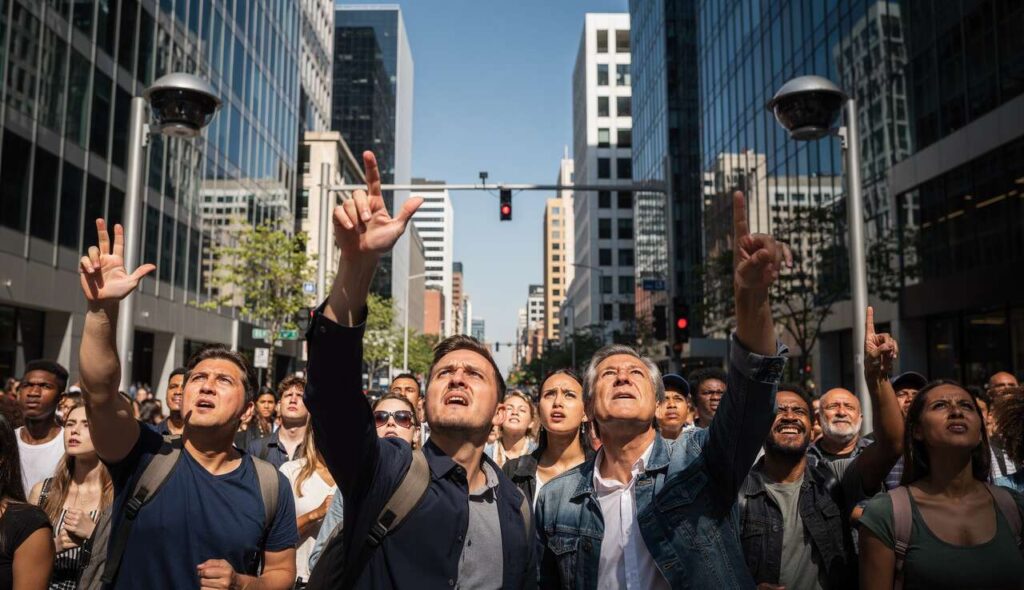
Across cities worldwide, a quiet rebellion is taking shape on street corners and public squares. Ordinary citizens are confronting an increasingly pervasive presence in their daily lives: artificial intelligence-powered surveillance cameras. What began as isolated acts of protest has evolved into organised movements challenging the unchecked expansion of facial recognition technology and algorithmic monitoring in public spaces. From spray paint to legal challenges, people are demanding answers about who watches them, how their data is used, and whether democratic societies can function when every movement is tracked and analysed.
The rise of smart surveillance cameras
Technological capabilities transforming public monitoring
Modern surveillance systems bear little resemblance to their predecessors. Today’s AI-enabled cameras possess capabilities that extend far beyond simple recording. These devices employ sophisticated algorithms to identify individuals through facial recognition, analyse behavioural patterns, and predict potential criminal activity before it occurs. Machine learning models process millions of data points simultaneously, creating detailed profiles of citizens’ movements, associations, and habits.
The technology has proliferated at an extraordinary pace, with installations appearing in:
- Transport hubs including railway stations and airports
- Shopping districts and commercial centres
- Residential neighbourhoods and housing estates
- Educational institutions and public buildings
- Parks and recreational spaces
The scale of deployment
Statistics reveal the staggering extent of this surveillance infrastructure. Cities across Europe, Asia, and North America have installed hundreds of thousands of smart cameras, creating networks that blanket entire metropolitan areas.
| Region | Estimated Smart Cameras | Coverage Type |
|---|---|---|
| London | 627,000+ | Citywide network |
| Beijing | 1,150,000+ | Comprehensive surveillance |
| New York City | 18,000+ | Strategic locations |
Authorities justify these installations by citing public safety concerns, crime prevention, and counter-terrorism measures. However, the rapid expansion has occurred with minimal public consultation, raising fundamental questions about consent and oversight. This technological proliferation has not gone unnoticed by communities who increasingly question whether safety justifies such intrusive monitoring.
The ethical issues of digital surveillance
Privacy erosion in democratic societies
The deployment of AI surveillance raises profound ethical dilemmas that strike at the heart of democratic principles. Privacy advocates argue that constant monitoring fundamentally alters the relationship between citizens and the state, creating an atmosphere of perpetual scrutiny that chills free expression and assembly. When individuals cannot move through public spaces without being tracked, identified, and analysed, the very concept of anonymity disappears.
Algorithmic bias and discrimination
Research has consistently demonstrated that facial recognition systems exhibit significant accuracy disparities across demographic groups. Studies reveal that these technologies misidentify individuals from ethnic minorities at substantially higher rates than white subjects, leading to:
- Wrongful arrests and criminal accusations
- Disproportionate targeting of marginalised communities
- Reinforcement of existing societal biases
- Erosion of trust between police and communities
The chilling effect on civil liberties
Beyond technical flaws, surveillance systems create what legal scholars term a chilling effect on fundamental freedoms. When citizens know their attendance at protests, religious gatherings, or political meetings is recorded and analysed, many choose self-censorship over exercising their rights. This invisible constraint on liberty operates without formal prohibition, making it particularly insidious in societies that value freedom of assembly and expression.
These mounting concerns have catalysed a growing movement of citizens refusing to accept surveillance as inevitable, prompting direct action across multiple fronts.
Civic actions against AI surveillance
Grassroots mobilisation strategies
Citizens have adopted diverse tactics to resist surveillance expansion. Community organisations have emerged specifically to challenge camera installations, employing both legal and extralegal methods to disrupt monitoring systems. These groups combine traditional activism with technological countermeasures, creating a multifaceted resistance movement.
Common approaches include:
- Physically disabling cameras through vandalism or obstruction
- Organising public demonstrations and awareness campaigns
- Filing legal challenges and freedom of information requests
- Developing technological tools to evade facial recognition
- Lobbying local councils to reject surveillance contracts
Creative forms of protest
Activists have demonstrated remarkable creativity in their resistance. Some have designed adversarial fashion incorporating patterns that confuse facial recognition algorithms. Others have organised coordinated actions where dozens of participants simultaneously wear masks or reflective materials, overwhelming surveillance systems with false data. Street artists have transformed cameras into public art installations, highlighting their presence whilst rendering them inoperative.
Digital rights advocacy
Alongside direct action, digital rights organisations have mounted sophisticated advocacy campaigns challenging the legal foundations of mass surveillance. These groups have successfully pressured technology companies to reconsider contracts with law enforcement agencies and have educated the public about the implications of AI monitoring. Their work has shifted public discourse, making surveillance a mainstream political issue rather than a niche concern.
These varied approaches have generated tangible results in specific locations, demonstrating that citizen resistance can influence surveillance policy.
Iconic cases of local resistance
San Francisco’s pioneering ban
In a landmark decision, San Francisco became the first major city to prohibit municipal use of facial recognition technology. The ban resulted from sustained advocacy by civil liberties groups who documented the technology’s inaccuracies and potential for abuse. Local activists presented compelling evidence to city supervisors, demonstrating how surveillance disproportionately affected marginalised communities whilst providing questionable security benefits.
European neighbourhood victories
Across Europe, residents have successfully challenged surveillance installations in their communities. In one notable case, residents of a housing estate in Sheffield mounted a legal challenge against their landlord’s installation of facial recognition cameras, arguing the technology violated privacy rights and was deployed without proper consultation. The sustained campaign attracted national media attention and ultimately forced the removal of the systems.
Student-led resistance movements
Educational institutions have become battlegrounds for surveillance debates. University students have organised protests against campus facial recognition systems, arguing that academic freedom requires spaces free from constant monitoring. In several instances, student pressure has convinced administrators to abandon or significantly limit surveillance plans, establishing important precedents for institutional accountability.
These victories, whilst localised, have demonstrated the potential for citizen action to reshape surveillance policy and inspired similar efforts elsewhere.
Results and impacts of citizen movements
Policy changes and legislative responses
Citizen resistance has produced measurable policy outcomes. Multiple jurisdictions have enacted moratoriums or outright bans on facial recognition technology following public pressure. These legislative victories represent significant achievements for privacy advocates and demonstrate that democratic processes can constrain surveillance expansion when citizens actively engage.
| Jurisdiction | Action Taken | Year Implemented |
|---|---|---|
| San Francisco | Complete ban on municipal use | 2019 |
| Boston | Prohibition on facial recognition | 2020 |
| European Parliament | Proposed restrictions on public surveillance | 2021 |
Corporate accountability measures
Activist pressure has also influenced corporate behaviour. Several major technology companies have suspended sales of facial recognition systems to law enforcement agencies following sustained criticism. Whilst some view these decisions as primarily public relations exercises, they nonetheless represent acknowledgement that unchecked surveillance deployment faces growing public opposition.
Shifting public consciousness
Perhaps most significantly, resistance movements have transformed public awareness about surveillance technologies. Polls indicate increasing scepticism about AI monitoring systems, with majorities in several countries expressing concern about privacy implications. This evolving public sentiment creates political pressure for stronger regulation and oversight.
These achievements have energised calls for comprehensive legal frameworks governing surveillance technologies.
Towards stricter regulation of surveillance technologies
Emerging regulatory frameworks
Governments are beginning to respond to public concerns with regulatory proposals aimed at constraining surveillance expansion. The European Union has advanced legislation that would severely restrict real-time facial recognition in public spaces, requiring specific authorisation for limited use cases. These proposals represent the most comprehensive attempt to regulate AI surveillance within democratic frameworks.
Key regulatory principles
Effective surveillance regulation must incorporate several fundamental principles:
- Mandatory transparency about system deployment and capabilities
- Public consultation before installation of monitoring technologies
- Independent oversight bodies with enforcement powers
- Strict limitations on data retention and sharing
- Accountability mechanisms for algorithmic errors and misuse
- Regular audits assessing bias and accuracy
Challenges to implementation
Despite progress, significant obstacles remain. Law enforcement agencies argue that surveillance restrictions compromise public safety, whilst technology companies lobby against regulations they claim stifle innovation. Balancing legitimate security needs with privacy protection requires nuanced policymaking that avoids both unchecked surveillance and naive rejection of useful technologies.
The path forward
Meaningful regulation demands sustained citizen engagement alongside political will. Advocacy groups emphasise that surveillance governance cannot be left to technical experts or security officials alone. Democratic oversight requires ongoing public participation in decisions about what monitoring is acceptable, under what circumstances, and with what safeguards. The resistance movements that have emerged represent not opposition to security but insistence that security measures respect fundamental rights.
The surveillance debate ultimately concerns the type of society we wish to inhabit. Citizens rising against AI monitoring systems are asserting that technological capability does not justify deployment, that efficiency cannot override liberty, and that democratic societies require spaces where individuals can exist free from perpetual scrutiny. Their resistance has already achieved significant victories, demonstrating that the expansion of surveillance infrastructure is neither inevitable nor irreversible. As regulatory frameworks develop, the activism that challenged unchecked monitoring will remain essential to ensuring that oversight mechanisms possess genuine teeth and that privacy protections reflect societal values rather than corporate or governmental convenience. The outcome of this struggle will shape the relationship between citizens and authority for generations.