



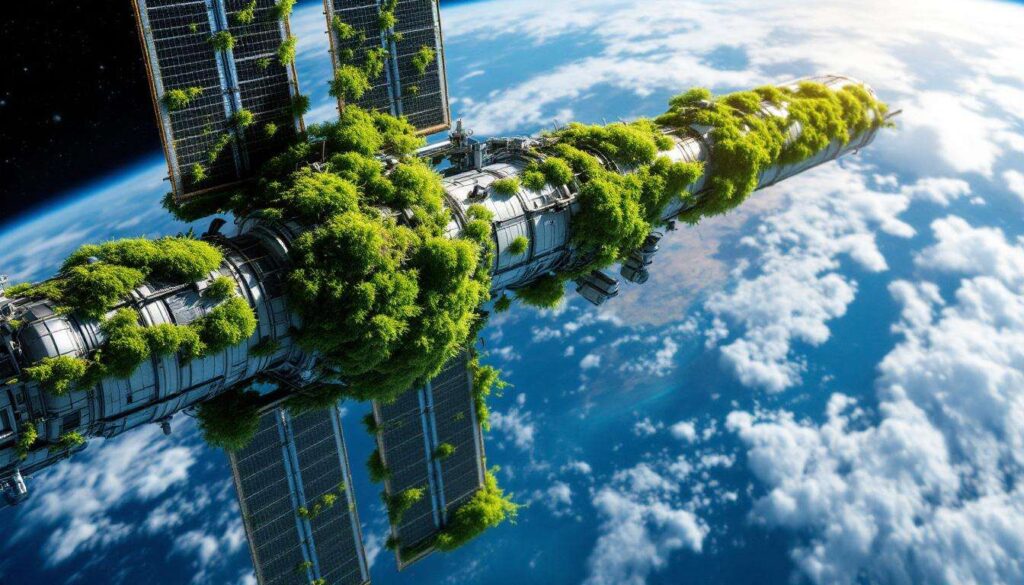
Scientists have successfully demonstrated that moss can survive the harsh conditions of outer space, marking a significant milestone in our understanding of life’s resilience beyond Earth. Researchers placed samples of the hardy plant on the exterior of the International Space Station for an extended period, exposing it to extreme temperatures, cosmic radiation, and the vacuum of space. Upon retrieval and return to terrestrial laboratories, the moss not only survived but continued to grow, offering fascinating insights into the adaptability of certain organisms and their potential role in future space exploration missions.
Moss aboard the International Space Station
Selection and preparation of the specimens
The research team carefully selected Syntrichia caninervis, a species of moss known for its exceptional drought tolerance and ability to withstand environmental extremes. This particular variety grows naturally in desert regions across several continents, making it an ideal candidate for space exposure experiments. Scientists prepared multiple samples, ensuring they were in optimal condition before launch.
The moss specimens were secured in specially designed containers that allowed direct exposure to the space environment whilst preventing them from floating away. These containers were mounted on external platforms of the International Space Station, where they would face the full brunt of space conditions without any protective shielding.
Duration and monitoring of the experiment
The experiment lasted for nine months, during which the moss experienced:
- Temperature fluctuations ranging from minus 150 to plus 100 degrees Celsius
- Intense ultraviolet radiation far exceeding levels on Earth
- Exposure to cosmic rays and solar particle events
- Complete vacuum conditions with no atmospheric pressure
- Microgravity effects on cellular structures
Throughout this period, the samples remained in their exposed positions, accumulating data that would later prove invaluable to researchers studying extremophile organisms. This lengthy exposure period provided sufficient time to assess the moss’s ability to withstand prolonged space conditions rather than brief exposure.
The success of this initial phase set the stage for examining how space conditions fundamentally altered the moss at a cellular level.
Impact of space conditions on moss growth
Cellular and molecular changes observed
Upon detailed examination, scientists discovered that the moss had undergone remarkable cellular adaptations to survive the extreme environment. The plant’s cells showed evidence of protective mechanisms, including the production of specialised proteins that shielded DNA from radiation damage. Microscopic analysis revealed that cell walls had thickened, providing additional structural integrity against the vacuum of space.
The research team documented significant changes in gene expression patterns. Certain genes associated with stress response were activated at much higher levels than in Earth-based control samples. These genetic modifications appeared to trigger the production of antioxidants and other protective compounds that helped the moss withstand radiation and extreme temperatures.
Comparison with Earth-based control samples
| Characteristic | Space-exposed moss | Earth control samples |
|---|---|---|
| Cell wall thickness | Increased by 23% | Normal baseline |
| Protective protein levels | Elevated 3.5 times | Standard levels |
| DNA damage markers | Present but repairable | Minimal |
| Photosynthetic capacity | Reduced initially | Optimal function |
These comparative findings highlighted the extraordinary adaptive capabilities of the moss, demonstrating that whilst space conditions imposed significant stress, the organism possessed inherent mechanisms to cope with such challenges.
Understanding these changes was crucial before attempting to revive the moss under terrestrial conditions.
Return to Earth: the challenges of survival
Rehydration and recovery protocols
Upon return to Earth, the primary challenge facing researchers was determining whether the desiccated, radiation-damaged moss could be successfully revived. The team implemented a carefully controlled rehydration process, gradually introducing moisture to avoid shocking the cellular systems. Initial attempts required precise monitoring of humidity levels, temperature, and light exposure to simulate optimal growing conditions.
The recovery protocol involved several stages:
- Gradual reintroduction to atmospheric pressure over 48 hours
- Controlled humidity increase from 30% to 80% over one week
- Filtered light exposure mimicking natural conditions
- Temperature stabilisation at optimal growth ranges
- Introduction of nutrient solutions after initial recovery signs
Observable signs of regeneration
Within days of rehydration, the moss began showing promising signs of life. Green pigmentation returned to previously brown, desiccated tissues, indicating that chlorophyll production had resumed. New growth appeared at the tips of stems, demonstrating that meristematic cells retained their capacity for division and differentiation despite months of dormancy in space.
Most remarkably, the moss achieved full photosynthetic function within three weeks of return, effectively resuming normal metabolic processes. This rapid recovery suggested that the adaptations developed in space were reversible, allowing the organism to transition back to Earth conditions without permanent impairment.
This successful revival prompted deeper investigation into what makes certain organisms capable of such extraordinary resilience.
Understanding the resilience of extremophile organisms
Mechanisms of extreme environment survival
The moss’s survival relies on several sophisticated biological mechanisms that enable it to enter a state of cryptobiosis, essentially suspending all metabolic activity until favourable conditions return. During this dormant state, cellular processes slow to nearly undetectable levels, dramatically reducing the organism’s vulnerability to environmental damage.
Key survival strategies include:
- Production of trehalose sugars that protect cellular structures during dehydration
- Expression of late embryogenesis abundant proteins that prevent protein aggregation
- DNA repair enzymes that fix radiation-induced damage upon rehydration
- Antioxidant systems that neutralise harmful free radicals
- Flexible cell membranes that maintain integrity despite extreme conditions
Comparative studies with other extremophiles
Scientists have compared the moss’s capabilities with other known extremophiles, including tardigrades and certain bacteria. Whilst tardigrades can survive similar conditions, the moss represents a more complex multicellular organism, making its resilience particularly noteworthy. This complexity suggests that sophisticated survival mechanisms can evolve in higher plant forms, not just in microscopic organisms.
These insights into resilience mechanisms naturally lead to considerations of how such knowledge might be applied to future endeavours beyond our planet.
Implications for the future of space biology
Potential for life support systems
The successful space survival of moss opens possibilities for developing biological life support systems for long-duration space missions. Moss could potentially be cultivated on spacecraft or planetary habitats to produce oxygen through photosynthesis, recycle carbon dioxide, and contribute to water purification systems. Its minimal resource requirements and resilience make it an attractive option for closed-loop ecological systems.
Terraforming considerations
Looking further ahead, hardy organisms like this moss species could play a role in planetary terraforming efforts. Their ability to survive extreme conditions suggests they might establish themselves on hostile planetary surfaces, gradually creating conditions more suitable for other life forms. Whilst terraforming remains largely theoretical, understanding which organisms can survive in space environments is a crucial first step.
Beyond space applications, this research also holds promise for addressing challenges here on Earth.
Potential applications on Earth and beyond
Agricultural and environmental benefits
Understanding the genetic and biochemical mechanisms that enable moss to survive extreme conditions could inform the development of drought-resistant crops. Agricultural scientists are particularly interested in identifying specific genes responsible for desiccation tolerance, which could potentially be introduced into food crops facing increasingly challenging climate conditions.
Environmental restoration projects could also benefit from these resilient organisms. Moss species with enhanced survival capabilities might be deployed in degraded ecosystems, helping to stabilise soil, retain moisture, and create microhabitats for other organisms in areas previously considered too harsh for revegetation.
Biotechnology and research applications
The protective proteins and compounds produced by space-exposed moss have attracted attention from biotechnology researchers. These molecules might have applications in preserving biological materials, developing new pharmaceuticals, or creating protective coatings for sensitive equipment. The unique stress-response mechanisms observed in the moss could inspire novel approaches to biological preservation and storage.
This research demonstrates that life’s boundaries extend far beyond what was previously imagined, offering hope for both terrestrial applications and future space exploration endeavours.
The successful exposure and revival of moss after nine months on the International Space Station represents a remarkable achievement in space biology. This experiment has demonstrated that complex plant life can withstand the vacuum of space, extreme radiation, and temperature fluctuations whilst retaining the capacity to resume growth upon return to favourable conditions. The cellular adaptations observed in the moss provide valuable insights into survival mechanisms that could inform future space missions and agricultural development. As humanity continues to explore beyond Earth, understanding which organisms can survive in extraterrestrial environments becomes increasingly important, and this resilient moss has proven itself a promising candidate for supporting life in space.