



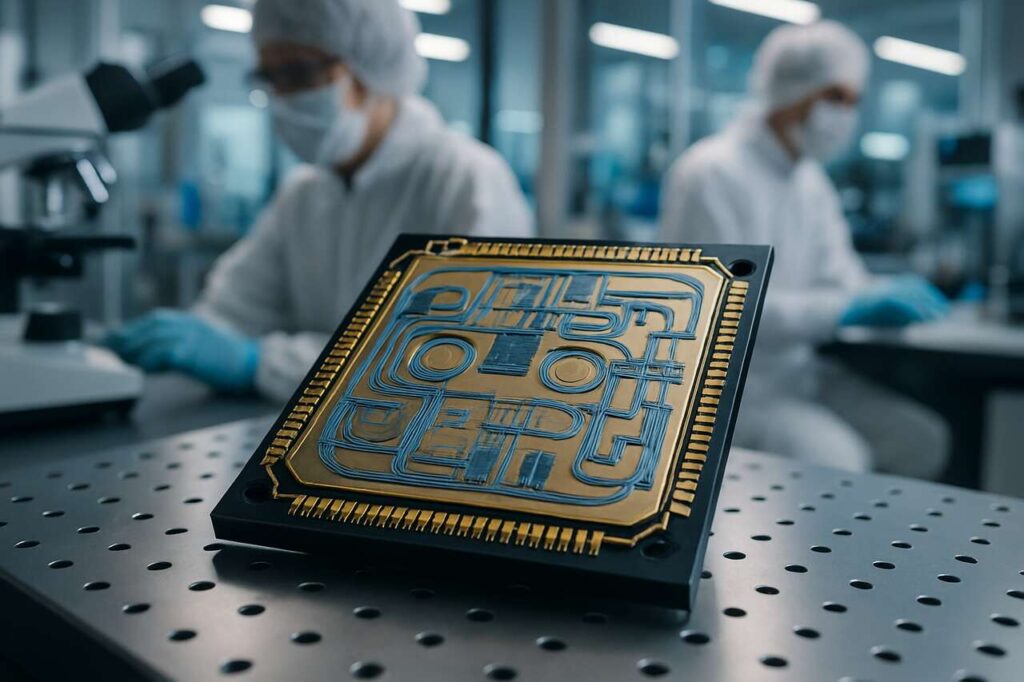
Quantum computing has long been heralded as the next frontier in technological advancement, promising computational power that far exceeds the capabilities of classical systems. Recent breakthroughs in silicon photonics have brought this vision closer to reality, with researchers successfully demonstrating a three-qubit quantum register integrated within a silicon photonic chip. This achievement represents a significant milestone in the quest to develop scalable and practical quantum computers that can operate at room temperature whilst maintaining the delicate quantum states necessary for computation.
Revolutionary discovery in silicon quantum circuits
Breaking new ground in quantum integration
The realisation of a three-qubit quantum register on a silicon photonic chip marks a paradigm shift in quantum computing architecture. Unlike traditional approaches that rely on superconducting circuits or trapped ions, this method harnesses the properties of photons travelling through silicon waveguides to encode and manipulate quantum information. The breakthrough lies in the ability to generate, control and measure multiple qubits on a single chip using established semiconductor manufacturing techniques.
Key innovations that enabled this discovery include:
- Advanced photon pair generation using spontaneous four-wave mixing
- Precise control mechanisms for individual qubit manipulation
- High-fidelity quantum state readout systems
- Integration of multiple quantum gates on a compact platform
Technical achievements and quantum fidelity
The research team achieved quantum gate fidelities exceeding 90 per cent, a crucial threshold for error correction protocols. This level of precision demonstrates that silicon photonic platforms can maintain quantum coherence whilst performing complex operations. The three-qubit register successfully executed entanglement operations, creating Bell states and demonstrating quantum correlations that have no classical equivalent.
| Metric | Achievement |
|---|---|
| Gate fidelity | 90%+ |
| Qubit count | 3 |
| Operating temperature | Room temperature |
| Chip size | Sub-millimetre scale |
These technical accomplishments pave the way for understanding how multi-qubit systems can be successfully integrated into existing manufacturing infrastructure.
Successful integration of a three-qubit register
Architecture and design principles
The three-qubit quantum register employs a modular architecture where each qubit is encoded in the quantum state of individual photons. The silicon chip incorporates specialised components including microring resonators, directional couplers and phase shifters that work in concert to create a fully functional quantum processor. This design allows for independent control of each qubit whilst maintaining the quantum correlations necessary for entanglement.
Overcoming integration challenges
Integrating multiple qubits on a single chip presented several formidable challenges that researchers systematically addressed:
- Minimising photon loss through optimised waveguide design
- Reducing crosstalk between adjacent quantum circuits
- Ensuring uniform performance across all three qubits
- Developing robust calibration procedures for quantum gates
The successful demonstration of three-qubit entanglement proves that these challenges can be overcome through careful engineering and precise fabrication techniques. The register’s ability to perform quantum algorithms, albeit simple ones, validates the fundamental approach and suggests that scaling to larger systems is feasible.
Understanding these integration successes naturally leads to examining why silicon photonics offers such compelling advantages for quantum computing applications.
Advantages of silicon photonic chips
Compatibility with existing infrastructure
Silicon photonics leverages the mature semiconductor industry that has powered classical computing for decades. This compatibility offers several practical benefits that distinguish it from alternative quantum computing approaches. Fabrication facilities already equipped for silicon chip production can be adapted to manufacture quantum photonic circuits, dramatically reducing the barriers to commercial-scale production.
Operational and practical benefits
The advantages of silicon photonic quantum chips extend beyond manufacturing considerations:
- Room temperature operation eliminates expensive cryogenic cooling systems
- Photons exhibit natural resistance to certain types of environmental noise
- Optical interconnects enable high-bandwidth quantum communication
- Compact form factors allow for portable quantum devices
- Lower power consumption compared to superconducting alternatives
| Platform type | Operating temperature | Scalability |
|---|---|---|
| Superconducting | Millikelvin | Moderate |
| Trapped ion | Room temperature | Limited |
| Silicon photonic | Room temperature | High |
These inherent advantages position silicon photonics as a leading candidate for practical quantum computing implementations that can transition from laboratory demonstrations to real-world deployment.
With such promising technical characteristics established, attention naturally turns to how these systems might be applied to solve actual problems.
Potential applications of quantum technology
Near-term quantum applications
Three-qubit quantum registers, whilst modest in scale, already enable several proof-of-concept demonstrations that hint at future capabilities. These systems can implement basic quantum algorithms such as the Deutsch-Jozsa algorithm and simple quantum error correction codes. More importantly, they serve as testbeds for developing the control systems and software frameworks necessary for larger quantum computers.
Long-term transformative potential
As silicon photonic quantum systems scale beyond three qubits, they promise to revolutionise multiple fields:
- Drug discovery through quantum simulation of molecular interactions
- Cryptography and secure communications using quantum key distribution
- Financial modelling with quantum-enhanced optimisation algorithms
- Artificial intelligence accelerated by quantum machine learning
- Materials science exploring novel compounds through quantum simulation
The pharmaceutical industry stands to benefit particularly from quantum simulations that can model protein folding and drug-receptor interactions with unprecedented accuracy. Similarly, the financial sector could employ quantum algorithms to optimise portfolios and assess risk across complex market scenarios that overwhelm classical computers.
Realising these applications requires sustained effort from research communities worldwide, working collaboratively to overcome remaining obstacles.
International collaborations and research challenges
Global research initiatives
The development of silicon photonic quantum computers involves international partnerships spanning academic institutions, government laboratories and private companies. Research teams across North America, Europe and Asia contribute complementary expertise in photonics, quantum physics and semiconductor engineering. These collaborations accelerate progress by sharing resources, standardising measurement protocols and collectively addressing fundamental scientific questions.
Outstanding technical hurdles
Despite recent successes, several challenges must be resolved before silicon photonic quantum computers achieve practical utility:
- Scaling beyond small qubit numbers whilst maintaining coherence
- Developing efficient quantum error correction schemes
- Creating high-quality single-photon sources on-chip
- Improving detection efficiency for quantum measurements
- Reducing operational complexity for end users
The scalability question remains paramount. Whilst three qubits represent an important milestone, useful quantum computers will require hundreds or thousands of qubits working in concert. Researchers are exploring various architectures including modular systems where multiple chips connect through optical links to form larger quantum processors.
Addressing these challenges shapes the trajectory of quantum computing development and influences what the coming years might bring.
Future prospects for quantum computing
Roadmap for silicon photonic quantum systems
The successful demonstration of a three-qubit register provides a foundation for systematic scaling. Researchers anticipate progressing to ten-qubit systems within the near term, followed by fifty-qubit devices that could demonstrate quantum advantage for specific computational tasks. This incremental approach allows for thorough characterisation at each stage whilst building confidence in the underlying technology.
Convergence with classical computing
Future quantum computers will likely operate as specialised co-processors alongside classical systems, handling specific tasks where quantum mechanics provides advantages. Silicon photonics facilitates this hybrid approach through its compatibility with existing electronic circuits, enabling seamless integration of quantum and classical components on unified platforms.
The path forward requires sustained investment in research infrastructure, workforce development and international cooperation to transform laboratory demonstrations into transformative technologies that reshape computing paradigms.
The achievement of a three-qubit quantum register in silicon photonics represents more than an incremental advance; it validates a comprehensive approach to quantum computing that leverages established manufacturing techniques whilst operating at practical temperatures. Silicon photonic platforms offer unique advantages in scalability, compatibility and operational simplicity that position them favourably amongst competing quantum technologies. As research communities worldwide collaborate to address remaining challenges, the prospect of practical quantum computers capable of solving previously intractable problems moves steadily closer to reality. The journey from three qubits to fault-tolerant quantum processors will require patience and persistence, but the foundations are now firmly established.