


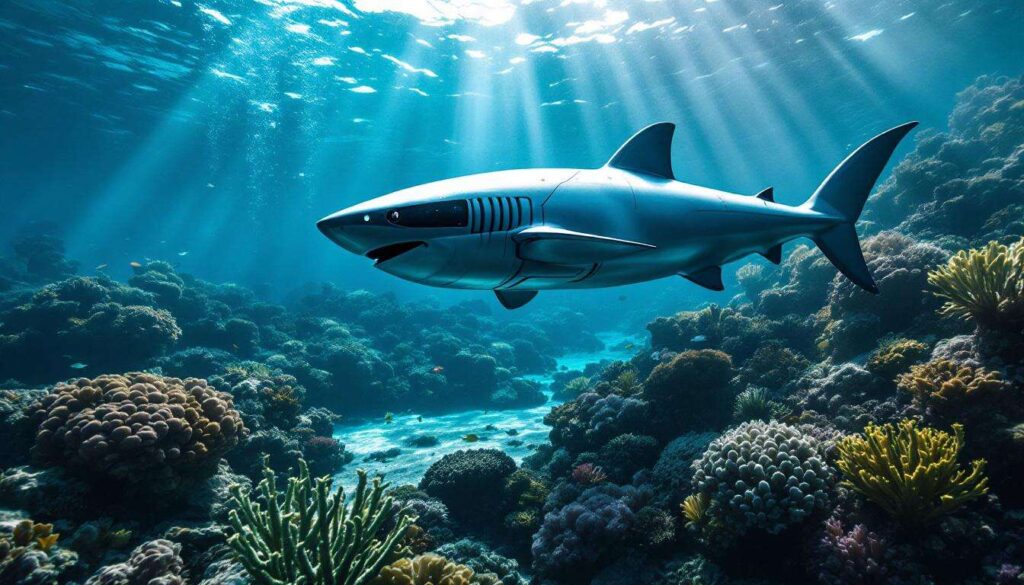
Subsea cables carry more than 95 per cent of international data traffic, forming the invisible backbone of global communications and digital commerce. These vital arteries of information stretch across ocean floors, vulnerable to damage from anchors, fishing gear, natural disasters and even deliberate sabotage. A revolutionary solution has emerged in the form of an autonomous underwater vehicle designed to mimic the efficient movement of a shark, offering unprecedented surveillance capabilities for protecting this critical infrastructure spanning hundreds of thousands of miles beneath the waves.
Introduction to the shark-shaped underwater robot
Design inspiration from nature
The biomimetic underwater robot draws its design principles directly from one of the ocean’s most efficient predators. Engineers have studied the hydrodynamic properties of sharks for years, recognising their ability to move silently through water with minimal energy expenditure. This latest innovation translates those natural advantages into a technological marvel capable of patrolling vast distances of seabed without frequent recharging or maintenance interventions.
Key physical characteristics
The robot incorporates several distinctive features that set it apart from conventional underwater vehicles:
- Flexible tail section that replicates the propulsion efficiency of biological sharks
- Streamlined body profile reducing drag by approximately 30 per cent compared to traditional designs
- Sensor arrays positioned along the body mimicking the lateral line system of real sharks
- Modular construction allowing for equipment upgrades and repairs
- Low acoustic signature ensuring minimal disruption to marine life
These design elements combine to create a surveillance platform that can operate autonomously for extended periods whilst maintaining exceptional manoeuvrability in challenging underwater environments. The transition from conventional boxy submersibles to this nature-inspired approach represents a significant leap in underwater robotics capabilities.
The technology behind the underwater robot
Propulsion and energy systems
The propulsion mechanism relies on undulating movements rather than traditional propellers, significantly reducing noise pollution and energy consumption. Advanced battery technology provides operational endurance of up to 72 hours on a single charge, with solar panels integrated into the dorsal surface for supplementary power generation when the robot surfaces for data transmission.
Navigation and sensing capabilities
Sophisticated artificial intelligence algorithms enable the robot to navigate complex underwater terrain without constant human oversight. The navigation suite includes:
- Acoustic positioning systems accurate to within two metres
- High-definition cameras with low-light enhancement
- Sonar arrays for obstacle detection and cable mapping
- Chemical sensors detecting leaks or unusual substances
- Temperature and pressure monitoring equipment
| Specification | Performance metric |
|---|---|
| Maximum depth | 3,000 metres |
| Cruising speed | 4 knots |
| Operational duration | 72 hours |
| Sensor range | 500 metres radius |
These technological foundations enable comprehensive monitoring of subsea infrastructure whilst adapting to changing environmental conditions and mission parameters.
The importance of subsea cables for global infrastructure
Scale of the subsea cable network
The global network of undersea telecommunications cables extends across approximately 800,000 miles of ocean floor, connecting continents and enabling instantaneous communication between billions of people. These cables carry financial transactions worth trillions of pounds annually, stream entertainment content, facilitate remote work and underpin cloud computing services that modern society depends upon.
Vulnerability and economic impact
Despite their critical importance, subsea cables face numerous threats. Accidental damage from fishing trawlers and ship anchors accounts for roughly 70 per cent of cable faults, whilst natural events such as underwater landslides and earthquakes contribute additional risk. Each cable break can cost millions in repairs and result in significant service disruptions affecting entire regions.
The economic consequences of cable damage extend far beyond immediate repair costs:
- Lost revenue for telecommunications providers during outages
- Interrupted financial trading potentially affecting market stability
- Degraded internet services impacting businesses and consumers
- Increased latency forcing data through alternative, longer routes
- National security concerns when critical communications infrastructure fails
Understanding these vulnerabilities highlights why innovative protection measures like shark-shaped surveillance robots have become essential investments for infrastructure operators.
How the robot secures subsea cables
Patrol and inspection protocols
The autonomous surveillance system follows pre-programmed routes along cable corridors, continuously scanning for potential threats or existing damage. Advanced image recognition software analyses visual data in real-time, identifying anomalies such as exposed cable sections, nearby anchors or unusual seabed disturbances that might indicate imminent problems.
Threat detection and response
When the robot identifies suspicious activity or potential hazards, it initiates a multi-stage response protocol. Initial assessment involves closer inspection using high-resolution cameras and additional sensor sweeps. If a genuine threat is confirmed, the system transmits detailed reports to human operators who can dispatch repair vessels or coordinate with maritime authorities to address the situation.
The robot’s capabilities include:
- Detecting fishing gear entanglements before they cause damage
- Identifying ships dropping anchor in prohibited zones
- Monitoring cable burial depth and sediment coverage
- Assessing structural integrity through thermal and acoustic imaging
- Documenting marine growth that might affect cable performance
This proactive approach shifts cable protection from reactive repairs to preventative maintenance, substantially reducing downtime and associated costs.
Economic and environmental benefits
Cost-effectiveness compared to traditional methods
Traditional cable inspection relied on manned submersibles or remotely operated vehicles tethered to surface vessels, both requiring expensive ship time and large crews. The shark-shaped robot operates autonomously, eliminating the need for constant surface support and reducing inspection costs by an estimated 60 per cent.
| Method | Daily operational cost | Coverage area |
|---|---|---|
| Traditional ROV with support vessel | £50,000 | 15 miles |
| Shark-shaped autonomous robot | £8,000 | 25 miles |
Environmental advantages
The ecological footprint of this technology represents a significant improvement over conventional approaches. The quiet operation minimises disturbance to marine mammals that rely on acoustic communication, whilst the absence of surface vessels reduces fuel consumption and associated emissions. The robot’s ability to detect environmental changes also provides valuable data for marine conservation efforts, creating a dual-purpose platform that serves both infrastructure protection and scientific research.
These combined benefits demonstrate how technological innovation can align economic imperatives with environmental responsibility.
Future outlook for underwater surveillance
Expanding applications
Beyond cable protection, the shark-shaped robot platform shows promise for numerous underwater applications. Oil and gas pipeline inspection, offshore wind farm maintenance, archaeological surveys and marine biology research all stand to benefit from this versatile technology. Development teams are already working on specialised variants optimised for specific tasks, suggesting a family of biomimetic robots may soon patrol the world’s oceans.
Technological evolution
Future iterations will likely incorporate enhanced artificial intelligence enabling swarm behaviour, where multiple robots coordinate their activities to cover larger areas more efficiently. Improved battery technology and energy harvesting systems may extend operational periods to weeks rather than days, whilst advanced materials could push depth ratings beyond current limitations.
The convergence of robotics, artificial intelligence and marine engineering promises to revolutionise how humanity interacts with and protects underwater infrastructure, ensuring the digital networks that connect our world remain secure and resilient.
The deployment of shark-shaped underwater robots marks a pivotal moment in subsea infrastructure protection. By combining biomimetic design with cutting-edge technology, these autonomous systems offer cost-effective, environmentally responsible surveillance of the cables that underpin global communications. As threats to underwater infrastructure continue evolving, such innovative solutions will prove increasingly vital for maintaining the connectivity upon which modern civilisation depends.