



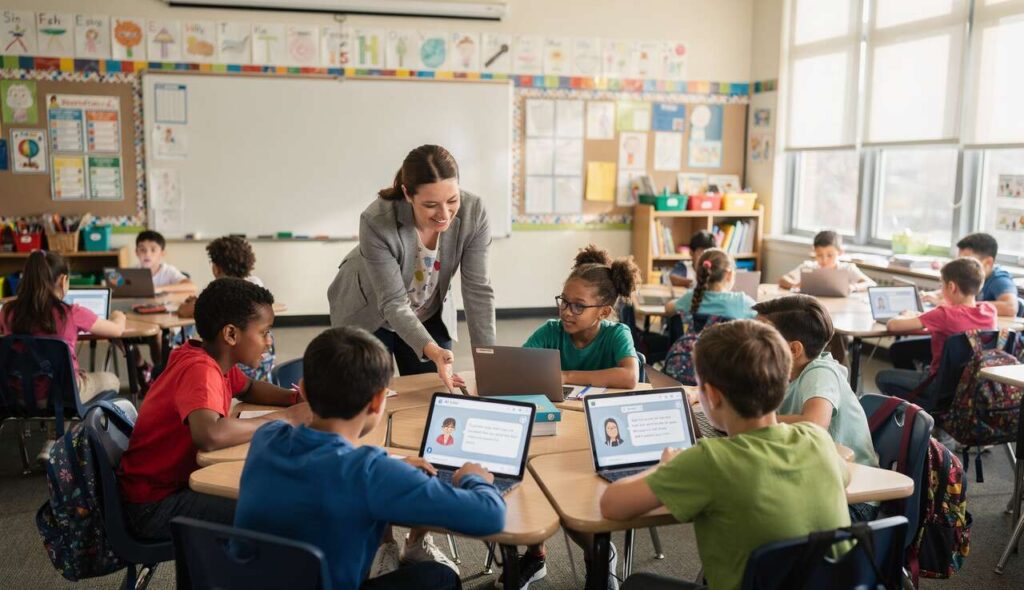
Artificial intelligence has entered the classroom with promises of personalised learning and enhanced educational outcomes. The proposal to provide each child with their own chatbot represents a significant shift in how we approach teaching and learning. Yet this model raises fundamental questions about the nature of education itself. Decades of research consistently demonstrate that learning is inherently social, shaped by interactions, dialogue, and collaborative experiences. As schools explore AI integration, educators and policymakers must examine whether individual chatbot models align with what we know about effective learning processes. The tension between technological innovation and pedagogical research demands careful consideration before widespread implementation.
The role of chatbots in digital education
Current applications in educational settings
Educational chatbots have emerged as versatile tools across various learning environments. These AI-powered assistants currently serve multiple functions within digital education:
- Providing instant responses to student queries outside classroom hours
- Offering automated feedback on assignments and exercises
- Delivering personalised content recommendations based on performance data
- Supporting administrative tasks such as scheduling and resource allocation
- Facilitating language learning through conversational practice
Many institutions have adopted chatbots primarily for supplementary support, positioning them as additional resources rather than primary teaching instruments. The technology demonstrates particular effectiveness in subjects requiring repetitive practice, such as mathematics and foreign languages.
The promise of personalisation
Adaptive learning systems represent the core appeal of educational chatbots. These programmes analyse individual performance patterns, identifying knowledge gaps and adjusting content difficulty accordingly. Proponents argue that this personalisation addresses the longstanding challenge of diverse learning paces within single classrooms. The technology theoretically enables each student to progress at an optimal speed, receiving targeted support precisely when needed.
However, the reality of implementation reveals complexities beyond algorithmic capabilities. The quality of personalisation depends heavily on programming sophistication, data accuracy, and the underlying pedagogical frameworks embedded within the software. These considerations lead naturally to examining what individual learning approaches can and cannot achieve.
Individual learning: advantages and limitations
Benefits of personalised pacing
Individual learning approaches facilitated by chatbots offer genuine advantages in specific contexts. Students who require additional time to master concepts can work without the pressure of keeping pace with classmates. Conversely, those who grasp material quickly can advance without waiting for others. This flexibility particularly benefits learners with specific educational needs or those whose circumstances require asynchronous learning opportunities.
The privacy of individual interaction with chatbots also reduces anxiety for some students. Those reluctant to ask questions in group settings may feel more comfortable seeking clarification from an AI assistant, potentially preventing knowledge gaps from widening.
Inherent constraints of isolated learning
Despite these benefits, significant limitations emerge when individual learning becomes the primary educational mode. Research consistently identifies several critical shortcomings:
- Reduced exposure to diverse perspectives and problem-solving approaches
- Limited development of communication and argumentation skills
- Decreased opportunities for peer teaching, which reinforces understanding
- Absence of spontaneous discovery through group discussion
- Minimal practice in negotiating meaning and resolving disagreements
| Learning aspect | Individual chatbot model | Social learning model |
|---|---|---|
| Content delivery | Highly personalised | Moderately personalised |
| Skill development | Technical focus | Comprehensive including social skills |
| Motivation sources | Algorithmic feedback | Peer interaction and recognition |
| Error correction | Immediate and consistent | Contextual and nuanced |
These limitations connect directly to fundamental aspects of how humans construct knowledge and develop cognitive capabilities through social engagement.
The importance of social interactions in the classroom
Constructivist theories of learning
Constructivist educational theory, pioneered by researchers such as Jean Piaget and Lev Vygotsky, establishes that knowledge construction occurs through social interaction. Vygotsky’s concept of the zone of proximal development particularly emphasises that learners achieve higher understanding through collaboration with more knowledgeable others, whether peers or teachers. This framework suggests that learning is not merely information transfer but active meaning-making within social contexts.
Contemporary neuroscience reinforces these theories, demonstrating that social engagement activates cognitive processes differently than solitary study. The brain regions involved in understanding others’ perspectives, processing emotional cues, and coordinating joint activities all contribute to deeper learning experiences.
Peer learning and collaborative problem-solving
Classroom interactions provide irreplaceable opportunities for cognitive development. When students work together on challenging problems, they engage in several valuable processes:
- Articulating their reasoning, which clarifies and strengthens understanding
- Encountering alternative approaches that expand cognitive flexibility
- Developing metacognitive awareness through observing others’ thinking
- Building resilience through shared struggle with difficult concepts
- Creating emotional connections to learning through shared discovery
Peer teaching particularly benefits both the explainer and the recipient. Students who teach concepts to classmates often achieve deeper mastery than through individual study alone. This phenomenon, sometimes called the protégé effect, highlights the active cognitive processing required to communicate knowledge effectively.
These social dimensions of learning extend beyond peer interactions to encompass the crucial relationship between students and teachers.
How student-teacher relationships enrich learning
The pedagogical value of human connection
Teacher-student relationships form the foundation of effective education. Experienced educators provide more than content delivery; they offer emotional support, intellectual challenge, and adaptive guidance that responds to subtle cues. Teachers recognise when students feel frustrated, confused, or disengaged, adjusting their approach accordingly. This responsive teaching cannot be fully replicated by algorithms, which lack genuine understanding of human emotional states and contextual nuances.
Research demonstrates that students’ perceptions of teacher care and support directly correlate with academic engagement and achievement. The motivational impact of a trusted mentor encouraging persistence through difficulties proves particularly significant for students facing challenges.
Modelling thinking and professional practice
Teachers serve as cognitive models, demonstrating expert thinking processes in real time. When educators think aloud whilst solving problems, they reveal the messy reality of authentic intellectual work, including false starts, revisions, and strategic decision-making. This modelling helps students develop their own metacognitive skills and realistic expectations about learning.
Furthermore, teachers embody professional standards and ethical considerations within their disciplines. They demonstrate how practitioners in various fields approach problems, evaluate evidence, and communicate findings. These implicit lessons about disciplinary culture and values resist codification in chatbot programming.
The integration of chatbot technology must therefore navigate the tension between individual AI assistance and these essential social dimensions of education.
The challenges of integrating chatbots in collaborative teaching
Risk of social isolation and reduced interaction
The one chatbot per child model potentially undermines collaborative learning by directing attention towards individual screens rather than shared experiences. When each student engages with their personal AI assistant, opportunities for spontaneous peer interaction diminish. Classrooms risk becoming collections of isolated individuals rather than learning communities.
This isolation carries particular concerns for social and emotional development. Schools serve vital functions beyond academic instruction, including helping young people develop interpersonal skills, emotional regulation, and collaborative capacities. Excessive focus on individual chatbot interaction may impede these developmental processes.
Equity and access considerations
Implementation of universal chatbot systems raises significant equity questions. Disparities in technological infrastructure, digital literacy, and home support create uneven playing fields. Students from disadvantaged backgrounds may lack reliable internet access or quiet spaces for online learning, exacerbating existing educational inequalities.
Additionally, the quality of AI systems varies considerably. Well-resourced schools might access sophisticated, pedagogically sound chatbots whilst others rely on basic programmes with limited capabilities. This technological divide risks widening achievement gaps rather than narrowing them.
Teacher deskilling and professional autonomy
Widespread chatbot adoption may inadvertently undermine teacher professionalism. If AI systems assume increasing instructional responsibilities, teachers might find their roles reduced to classroom management and technical troubleshooting. This deskilling threatens to devalue pedagogical expertise and reduce teaching to mechanical task execution.
Maintaining teacher autonomy and professional judgement remains essential for responsive, contextually appropriate education. These concerns suggest the need for thoughtful approaches that leverage technology without displacing fundamental educational relationships.
Perspectives for complementary and balanced use of technologies in the classroom
Hybrid models combining AI support and social learning
Balanced integration strategies position chatbots as supplementary tools rather than primary instructors. Effective models might include:
- Using chatbots for routine practice and immediate feedback on procedural tasks
- Reserving collaborative activities and complex problem-solving for group work
- Employing AI to identify struggling students who need targeted teacher intervention
- Leveraging chatbots for homework support whilst prioritising classroom interaction
- Designing activities where students critically evaluate chatbot responses together
This approach recognises that different learning objectives require different methods. Factual recall and procedural fluency may benefit from individual AI practice, whilst critical thinking and creativity flourish in social contexts.
Professional development and pedagogical innovation
Successful technology integration requires substantial teacher preparation. Educators need training not only in technical operation but in pedagogical strategies for blending AI tools with collaborative learning. Professional development should address how to maintain classroom community whilst incorporating individual technology use, and how to design activities that leverage both AI capabilities and human interaction.
Teachers also require support in developing critical perspectives on educational technology, enabling them to evaluate tools based on pedagogical soundness rather than marketing claims. This professional capacity ensures that technology serves educational goals rather than driving them.
Ongoing research and evaluation
The rapid deployment of educational AI demands rigorous, independent research examining actual outcomes. Studies must move beyond measuring immediate test score changes to assess broader impacts on social development, collaborative skills, motivation, and long-term learning. Longitudinal research can reveal effects that emerge only over time, such as changes in students’ capacity for independent thinking or their attitudes towards collaborative work.
Educational decisions should be guided by evidence rather than technological enthusiasm or commercial interests. Maintaining this research foundation protects students from becoming subjects in uncontrolled experiments with their education.
The integration of artificial intelligence into classrooms represents neither inevitable progress nor inherent threat, but rather a choice requiring careful consideration. Research evidence clearly demonstrates that learning is fundamentally social, shaped by interactions with peers and teachers. The one chatbot per child model risks undermining these essential collaborative processes in pursuit of individualised efficiency. Effective education requires balanced approaches that leverage AI capabilities for appropriate tasks whilst preserving the irreplaceable value of human connection and social learning. Teachers must remain central to educational practice, supported by technology rather than replaced by it. As schools navigate this technological transition, commitment to evidence-based pedagogy and student wellbeing should guide implementation decisions, ensuring that innovation serves genuine educational improvement rather than technological novelty.