



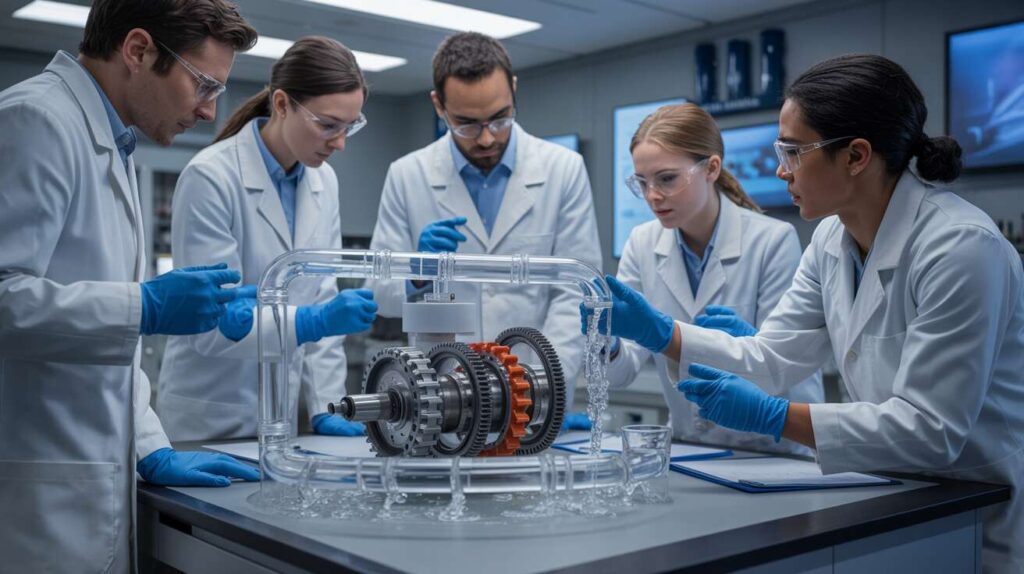
Mechanical engineering has long relied on traditional materials such as metal and plastic to create the gears that power countless machines and robotic systems. However, researchers in the United States have recently unveiled an innovative approach that could transform how we design durable mechanisms. By harnessing the unique properties of water as a functional component within gear systems, scientists have opened new possibilities for creating machinery that operates with reduced friction, enhanced longevity, and improved environmental compatibility. This breakthrough represents a significant departure from conventional engineering paradigms and promises to address some of the most persistent challenges facing modern robotics and industrial equipment.
Introduction to water-driven gears
The fundamental concept behind water-based mechanisms
Water-driven gears utilise liquid films and hydraulic principles to facilitate movement between mechanical components rather than relying solely on solid-to-solid contact. The system incorporates specially designed channels and chambers that maintain a thin layer of water between gear teeth during operation. This aqueous interface serves multiple functions simultaneously, acting as both a lubricant and a cushioning medium that absorbs shock and distributes forces more evenly across contact surfaces. The technology builds upon established principles of hydrodynamic lubrication whilst introducing novel structural elements that ensure the water remains precisely where needed throughout the operational cycle.
Engineering innovations enabling the technology
Developing functional water-driven gears required researchers to overcome several technical obstacles. The team created micro-textured surfaces with precisely controlled geometries that retain water through capillary action and surface tension effects. Advanced materials with specific wettability characteristics ensure the aqueous layer maintains its integrity even under varying operational conditions. The gears incorporate:
- Hydrophilic surface treatments that promote water adhesion
- Micro-groove patterns that facilitate controlled fluid distribution
- Sealed housing designs that prevent water loss through evaporation
- Temperature regulation systems that maintain optimal fluid viscosity
These engineering solutions work in concert to create a self-maintaining system where water continuously circulates and regenerates the protective interface between moving parts. The innovation extends beyond simple lubrication, fundamentally reimagining how mechanical energy transfers through gear assemblies.
Advantages of water-driven gears for robotics
Reduced friction and energy efficiency
The presence of a continuous water layer between gear surfaces dramatically reduces friction coefficients compared to traditional dry or oil-lubricated systems. This reduction translates directly into improved energy efficiency, as less power is lost to heat generation during operation. Robotic systems equipped with water-driven gears demonstrate measurably lower energy consumption during repetitive tasks, extending battery life in autonomous applications and reducing operational costs in tethered systems. The hydrodynamic cushioning effect also minimises vibration transmission, resulting in smoother motion profiles that enhance precision in delicate manipulation tasks.
Enhanced operational lifespan
Water’s natural properties contribute to significantly extended component longevity. Unlike petroleum-based lubricants that degrade over time and accumulate contaminants, water can be continuously filtered and refreshed within the gear system. The reduced wear rates observed in laboratory testing suggest that water-driven gears could operate for substantially longer periods before requiring replacement. This advantage proves particularly valuable in robotics applications where maintenance access is limited or costly, such as underwater exploration vehicles or space-based systems.
Environmental and safety benefits
The use of water as the primary functional fluid offers compelling environmental advantages over conventional lubricants. Water-driven systems eliminate concerns about toxic chemical leaks, making them ideal for robots operating in sensitive ecosystems or food production environments. The technology also reduces fire hazards in high-temperature applications where traditional lubricants might ignite. These characteristics position water-driven gears as an attractive option for the growing field of collaborative robotics, where machines work alongside humans in shared spaces.
Possible applications in industry
Manufacturing and production environments
Industrial manufacturing stands to benefit considerably from water-driven gear technology. Production facilities could deploy cleaner, quieter machinery that requires less frequent maintenance interventions. The technology shows particular promise in:
- Food processing equipment where contamination prevention is paramount
- Pharmaceutical manufacturing requiring sterile operating conditions
- Textile production machinery operating in temperature-sensitive environments
- Precision assembly systems demanding consistent, vibration-free motion
Marine and underwater applications
The natural compatibility between water-driven gears and aquatic environments creates opportunities for revolutionary underwater machinery. Submersible robots, oceanographic research equipment, and offshore energy infrastructure could all incorporate this technology to achieve better performance in challenging conditions. The elimination of oil-based lubricants prevents marine pollution whilst the self-cooling properties of water address thermal management challenges that typically plague submerged mechanical systems.
Medical and healthcare devices
Healthcare applications represent another promising frontier for water-driven gear technology. Surgical robots and diagnostic equipment could benefit from the biocompatible, non-toxic nature of water-based systems. The reduced noise levels associated with water-driven mechanisms would create quieter operating theatres and patient care environments. Rehabilitation devices and prosthetic limbs might also incorporate this technology to achieve more natural, fluid movements whilst maintaining safety in direct contact with human tissue.
Impact on machinery durability
Wear reduction mechanisms
Laboratory analyses reveal that water-driven gears exhibit substantially lower wear rates compared to conventional alternatives. The continuous aqueous interface prevents metal-to-metal contact that typically causes surface degradation through adhesive and abrasive wear mechanisms. Comparative testing demonstrates:
| Gear Type | Wear Rate (μm/1000 hours) | Expected Lifespan (hours) |
|---|---|---|
| Traditional dry gears | 12-18 | 5,000-8,000 |
| Oil-lubricated gears | 4-7 | 15,000-25,000 |
| Water-driven gears | 1-2 | 50,000-80,000 |
Resistance to contamination
Water-driven systems demonstrate remarkable resilience against particulate contamination that would compromise traditional gears. The flowing water naturally carries away debris and prevents accumulation in critical contact zones. Integrated filtration systems remove contaminants before they can cause damage, creating a self-cleaning mechanism that maintains optimal performance throughout the operational lifecycle.
Perspective on technological innovation
This development represents a broader trend towards biomimetic engineering solutions that draw inspiration from natural systems. Just as biological joints utilise synovial fluid to achieve remarkable durability and efficiency, water-driven gears apply similar principles to mechanical systems. The innovation challenges conventional assumptions about materials and design, demonstrating that sometimes the most effective solutions involve reimagining fundamental approaches rather than incrementally improving existing technologies. The success of water-driven gears may inspire researchers to explore other unconventional fluids and materials, potentially unlocking entirely new categories of mechanical systems with unprecedented capabilities.
Future challenges and issues for research
Technical limitations to address
Despite promising initial results, several technical hurdles remain before water-driven gears achieve widespread adoption. Researchers must develop solutions for:
- Operation in freezing temperatures where water solidification poses risks
- High-speed applications where cavitation might compromise performance
- Extreme load conditions that could disrupt the aqueous interface
- Long-term corrosion prevention in metallic components
Scaling and commercialisation considerations
Transitioning from laboratory prototypes to commercial products requires addressing manufacturing scalability and cost-effectiveness. Current production methods for creating the micro-textured surfaces remain expensive and time-consuming. Developing efficient, high-volume manufacturing processes will prove essential for making water-driven gears economically viable across diverse applications. Additionally, establishing industry standards and testing protocols will help build confidence among potential adopters and facilitate regulatory approval in safety-critical sectors.
The development of water-driven gears marks a significant milestone in mechanical engineering, offering substantial improvements in durability, efficiency, and environmental compatibility. By leveraging water’s natural properties within carefully designed mechanical systems, researchers have created technology with wide-ranging applications across robotics, manufacturing, and specialised industries. Whilst challenges remain in perfecting the technology and scaling production, the fundamental advantages demonstrated thus far suggest that water-driven gears could become a standard component in next-generation machinery, fundamentally changing how we approach mechanical design and operation.