



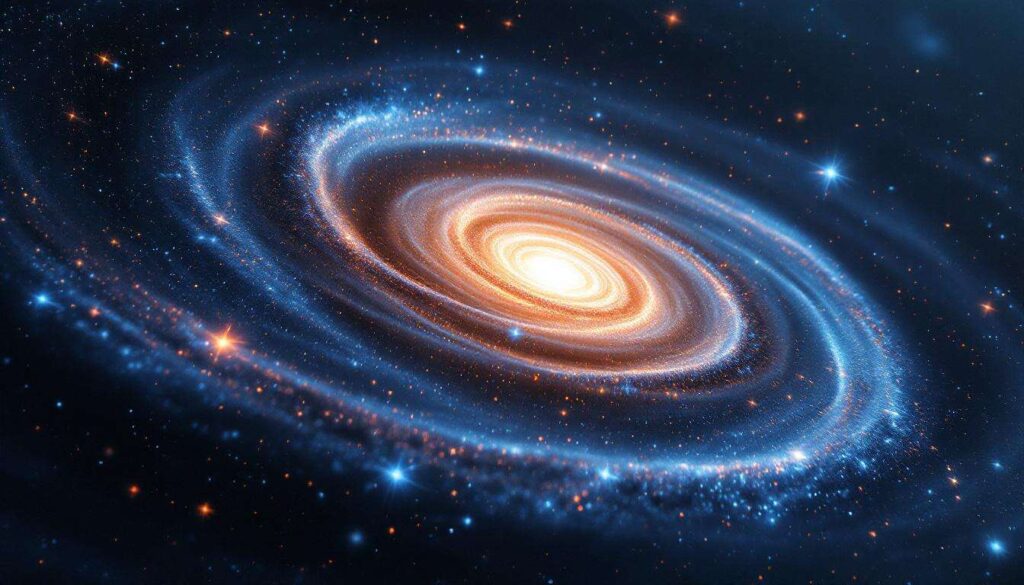
Galaxies spin faster than they should. Stars at the edges of spiral galaxies move at speeds that defy the gravitational pull of visible matter alone. This observation, first noted decades ago, has led scientists to propose the existence of an invisible substance that pervades the cosmos. Despite technological advances and countless experiments, this mysterious component remains undetected directly, making it one of the most perplexing enigmas facing modern physics.
What is dark matter ?
Dark matter represents an invisible form of matter that neither emits nor absorbs light or any other electromagnetic radiation. Scientists infer its existence through gravitational effects on visible matter, radiation, and the large-scale structure of the universe. The term itself reflects this characteristic: it is “dark” because it cannot be observed through conventional telescopes or detectors.
Composition and properties
Researchers believe dark matter consists of particles that interact only through gravity and possibly the weak nuclear force. Several candidates have been proposed:
- Weakly Interacting Massive Particles (WIMPs): hypothetical particles with masses between 10 and 1,000 times that of a proton
- Axions: extremely light particles originally proposed to solve problems in quantum chromodynamics
- Sterile neutrinos: hypothetical particles that interact even less than ordinary neutrinos
- Primordial black holes: black holes formed in the early universe rather than from stellar collapse
Unlike ordinary matter, dark matter does not clump together to form stars or planets. Instead, it forms vast halos around galaxies, providing the gravitational scaffolding upon which visible structures are built. This behaviour distinguishes it fundamentally from the baryonic matter that comprises everything we can observe directly.
Understanding what dark matter actually is remains crucial because it leads directly to examining why it matters so profoundly for cosmic architecture.
The importance of dark matter in the universe
Dark matter constitutes approximately 85% of all matter in the universe and about 27% of the universe’s total energy density. This overwhelming presence makes it a dominant force in cosmic evolution and structure formation.
Role in galaxy formation
Without dark matter, galaxies as we know them could not exist. Computer simulations demonstrate that visible matter alone cannot account for the observed structures. Dark matter provides the gravitational wells necessary for gas to collect and condense into stars and galaxies. During the early universe, tiny fluctuations in dark matter density grew through gravitational attraction, eventually pulling in ordinary matter to form the first cosmic structures.
Observational evidence
| Phenomenon | Evidence for dark matter |
|---|---|
| Galaxy rotation curves | Stars orbit at constant speeds regardless of distance from centre |
| Gravitational lensing | Light bends around galaxy clusters more than visible mass predicts |
| Cosmic microwave background | Temperature fluctuations require dark matter to match observations |
| Large-scale structure | Distribution of galaxies matches dark matter simulations |
The Bullet Cluster provides particularly compelling evidence. This system of two colliding galaxy clusters shows visible matter concentrated in one region whilst the gravitational centre of mass lies elsewhere, strongly suggesting the presence of invisible matter that passed through the collision.
Establishing its importance naturally raises questions about how scientists attempt to detect this elusive substance directly.
Current detection techniques
Scientists employ three primary strategies to detect dark matter particles, each targeting different aspects of potential interactions.
Direct detection experiments
These experiments search for dark matter particles colliding with atomic nuclei in ultra-sensitive detectors. Facilities are typically located deep underground to shield them from cosmic rays. Notable experiments include:
- XENON: uses liquid xenon to detect nuclear recoils from dark matter interactions
- LUX-ZEPLIN (LZ): employs 10 tonnes of liquid xenon in South Dakota
- CDMS: utilises cryogenic germanium and silicon detectors
Despite increasing sensitivity, these experiments have yet to produce confirmed detections, only establishing increasingly stringent limits on possible dark matter properties.
Indirect detection methods
Researchers also search for products of dark matter particle annihilation or decay. When dark matter particles collide, they might produce gamma rays, neutrinos, or antimatter particles detectable by space-based or ground-based observatories. The Fermi Gamma-ray Space Telescope and the IceCube Neutrino Observatory conduct such searches, though results remain inconclusive.
Collider experiments
The Large Hadron Collider attempts to create dark matter particles by smashing protons together at enormous energies. Scientists look for “missing energy” in collision events, which could indicate dark matter particles escaping detection. However, no definitive signals have emerged.
The persistent absence of positive results from these sophisticated approaches has prompted some researchers to consider whether alternative explanations might be necessary.
Alternative theories to dark matter
Whilst dark matter remains the prevailing hypothesis, several alternative theories attempt to explain observations without invoking invisible matter.
Modified Newtonian Dynamics (MOND)
Proposed in 1983, MOND suggests that Newton’s laws of gravity break down at extremely low accelerations, such as those experienced at galactic scales. This theory successfully predicts galaxy rotation curves without requiring dark matter. However, it struggles to explain phenomena like gravitational lensing and the Bullet Cluster observations.
Modified gravity theories
Various theories propose modifications to general relativity itself:
- f(R) gravity: alters Einstein’s equations by making them depend on functions of the Ricci scalar
- TeVeS: a relativistic version of MOND that attempts to address some of its shortcomings
- Emergent gravity: suggests gravity arises from quantum entanglement of particles
Whilst intriguing, these alternatives face significant challenges in matching the full range of cosmological observations that dark matter explains naturally.
Whether through dark matter or modified gravity, the field continues to grapple with fundamental obstacles that have persisted for decades.
Persistent challenges in research
Several interconnected difficulties continue to frustrate efforts to solve the dark matter puzzle.
The detection problem
If dark matter interacts only through gravity and possibly the weak force, it may be extraordinarily difficult to detect. The interaction cross-section might be so small that even the most sensitive detectors cannot register events above background noise. This raises the unsettling possibility that dark matter could remain forever beyond direct experimental reach.
Theoretical uncertainties
Without experimental guidance, theorists face an enormous parameter space. Dark matter particles could have any mass from a billionth of an electron volt to millions of solar masses. They might be stable or decay over cosmological timescales. This lack of constraints makes it difficult to design targeted experiments.
Small-scale structure discrepancies
Standard dark matter models predict more small satellite galaxies around large galaxies than observations reveal. They also predict denser cores in dwarf galaxies than measured. Whilst these issues might reflect limitations in modelling ordinary matter rather than problems with dark matter itself, they introduce uncertainty into the overall picture.
Despite these formidable obstacles, the scientific community remains committed to pursuing this mystery through innovative approaches and technologies.
The future of studying dark matter
Next-generation experiments and theoretical developments promise to probe dark matter with unprecedented precision.
Upcoming experiments
Several ambitious projects are under development or construction. The DARWIN detector will use 50 tonnes of liquid xenon, representing a significant scale-up from current experiments. The Vera C. Rubin Observatory will conduct the Legacy Survey of Space and Time, mapping billions of galaxies to study dark matter’s gravitational effects with extraordinary detail.
Novel approaches
Researchers are exploring unconventional detection methods, including searches for dark matter effects on quantum systems, precision measurements of atomic spectra, and gravitational wave observations that might reveal primordial black holes. These diverse strategies increase the chances of breakthrough discoveries.
Dark matter remains one of science’s most profound mysteries precisely because it challenges our understanding of the universe’s fundamental composition. Multiple lines of evidence point convincingly to its existence, yet it continues to elude direct detection despite decades of sophisticated experiments. Whether future research confirms dark matter’s particle nature, validates alternative theories, or reveals something entirely unexpected, solving this puzzle will fundamentally reshape our comprehension of cosmic reality and the laws governing it.